

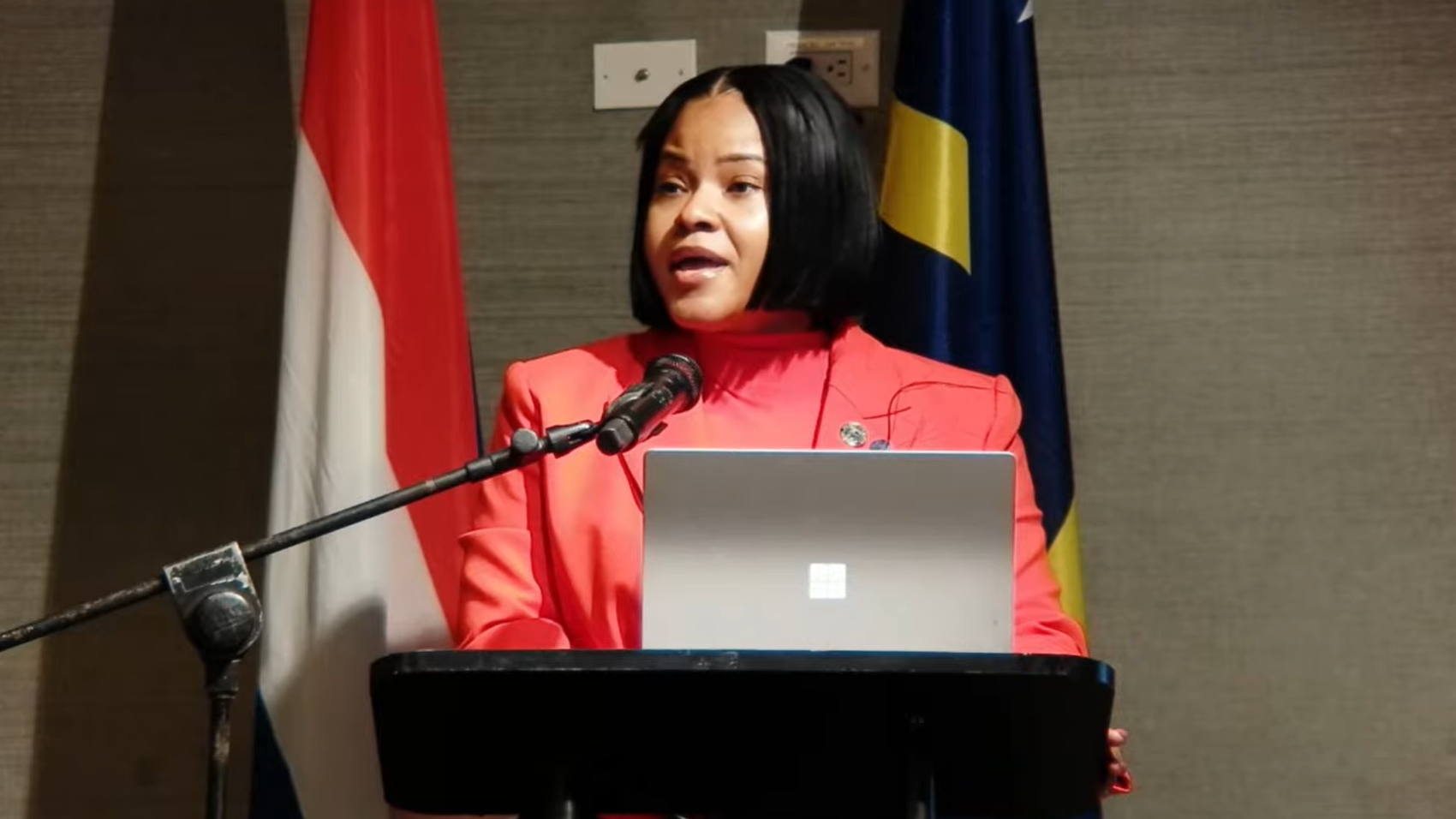
ORANJESTAD, Aruba--When MP Sjamira Roseburg delivered St. Maarten’s country update at IPKO on Thursday, she did more than list projects and policy priorities. Roseburg deliberately anchored several of her points in a November 2025 study commissioned by the Dutch Ministry of Health, Welfare and Sport (VWS) and authored by Dr. Alana Helberg-Proctor at the University of Amsterdam, a report that concludes slavery’s legacy can still shape health outcomes today, including both mental and physical health, and people’s experiences within the healthcare system. Roseburg is the Chairperson of the Committee of Kingdom Affairs and Interparliamentary Relations for St. Maarten.
Roseburg referenced the study as she argued that national development cannot be discussed in silos, especially in small island societies where education, health, labor, and social conditions overlap. In her presentation, she pointed to what she described as a reconfirmation in the research: that the history of slavery continues to affect mental and physical health, particularly among descendants of enslaved people, and she used that finding to justify long-term, cross-ministerial policy attention rather than symbolic gestures or one-off initiatives.
The report, titled Eindrapportage Gezondheidseffecten van Slavernij, and reported on by The Peoples' Tribune earlier this week, is described as an exploratory study, written in the context of a recognized knowledge gap in the Netherlands and Europe on how slavery’s legacy can continue to influence health. It draws on international literature and expert input to point to both direct and indirect pathways, including intergenerational trauma, present-day racism and discrimination, and broader social conditions that shape wellbeing and health access.
Roseburg’s choice to bring that report into an IPKO update was not incidental. She used it as a policy bridge, linking historical harm to present-day outcomes, then tying those outcomes to government responsibilities that sit across multiple ministries.
How she connected slavery legacy to education and youth policy
During her country update, Roseburg described government priorities in education, culture, youth, and sports as part of a holistic development agenda, emphasizing resilience, stronger support systems, and building national capacity. After citing the slavery health report, she folded the report’s theme into that same frame, presenting education and youth development not just as sector goals, but as part of long-term social repair.
In that context, Roseburg referenced work aimed at aligning education outcomes with labor market needs, strengthening professional development for educators, and increasing parental involvement, and she placed these efforts alongside broader resilience-focused initiatives for children and families.
Roseburg made her clearest link when she moved into public health and labor matters, telling the forum, in substance, that “it’s all connected,” then tying mental health challenges back to slavery’s legacy as reconfirmed in the November 2025 study.
She then outlined health and labor related efforts she said are underway, including plans geared toward a more equitable healthcare framework, stronger oversight, and improved safeguards for vulnerable people. In her presentation, she referenced initiatives and reforms in areas such as healthcare regulation and patient safety, mental health support, and legal protections connected to involuntary mental health admission, using the slavery legacy report as part of the rationale for why mental health must be treated as a national priority rather than a side issue.
How she framed it as a Kingdom-level conversation
Roseburg did not limit the slavery legacy discussion to domestic policy. In the exchange following her presentation, she argued that these conversations must also happen at the Kingdom level, including at IPKO itself. Her point was if leaders avoid the topic in the highest forums, it becomes unrealistic to expect the public to carry the conversation forward at home.
That position aligns with the report’s broader warning about knowledge gaps and the need for long-term attention. The report emphasizes that while the research base is still limited, the evidence is strong enough to justify deeper study and concrete responses, particularly where discrimination and social conditions intersect with health access and outcomes.
Lastly, Roseburg also widened the frame beyond health policy and program lists, arguing that the Kingdom cannot have an honest conversation about reform, autonomy, or oversight without first facing the historical foundations of today’s inequalities.
In her remarks to a questioned posed by Dutch MP Don Ceder, she stressed that before any country even begins to talk about “stepping out” or reshaping relationships, the countries must be clear on how they arrived at the current arrangement, including how wealth and opportunity were accumulated over time and how the Netherlands benefited within that history. Her point was that leaders cannot responsibly debate the future while avoiding the past, because people cannot understand where they are going if they are not willing to confront how they got here.
In essence, Roseburg framed a politically sensitive subject as a measurable policy concern. By citing a VWS-commissioned study and placing it inside an IPKO country update, she argued that the legacy of slavery is not only a cultural or historical discussion, it is a modern public health and human development issue that shows up in classrooms, clinics, workplaces, and social conditions.
The report itself, as summarized in reporting by The People’s Tribune, describes the ongoing influence of slavery as affecting both mental and physical health and shaping experiences within healthcare systems, while identifying racism, discrimination, and intergenerational trauma as key mechanisms discussed in international literature.
In practical terms, Roseburg’s message at IPKO was that St. Maarten’s policy response cannot be single-lane. If the evidence points to long-running harm expressed through health and social outcomes, then education policy, public health planning, labor protections, and social development measures must be coordinated, sustained, and treated as part of the same national project.
Photo caption: MP Sjamira Roseburg with MP Clifford Heyliger from Aruba who is also her relative.
Join Our Community Today
Subscribe to our mailing list to be the first to receive
breaking news, updates, and more.