

.jpg)


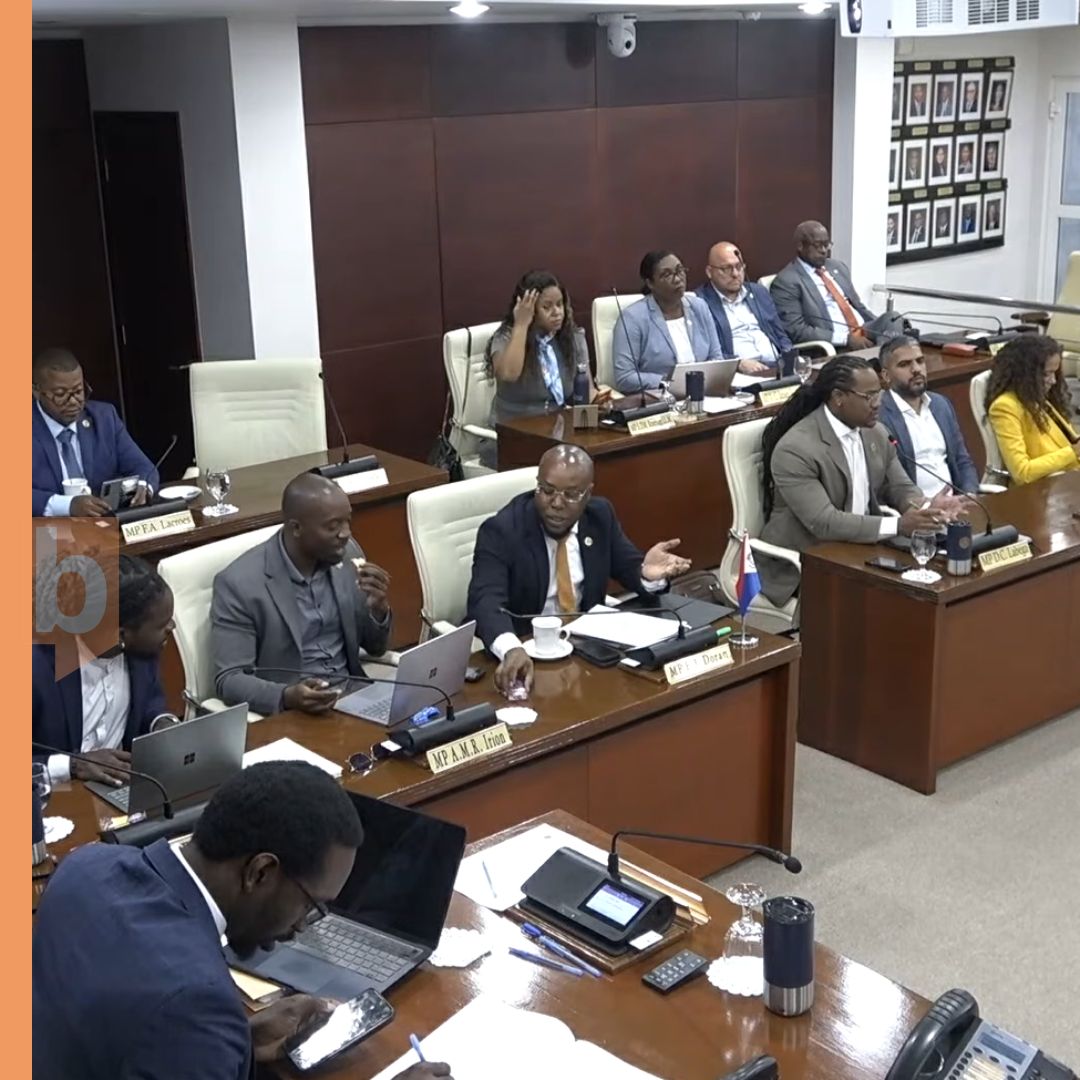
GREAT BAY--Members of Parliament used Monday’s Central Committee handling of the draft 2027 national budget to press Government on whether the hundreds of millions of guilders proposed for next year will translate into measurable improvements for residents, with questions ranging from food prices and GEBE bills to housing, healthcare, staffing shortages, taxation, roads, public safety and the financial condition of government-owned companies.
MP Lyndon Lewis presented a ministry-by-ministry series of questions focused largely on whether the figures in the budget are supported by realistic assumptions and whether Government has clear implementation targets. On Finance, Lewis questioned the projected XCG 19 million increase in tax revenue over the 2026 budget and asked Government to separate how much of the increase is expected from economic growth and how much from improved tax collection. He also sought details on the modernization of the Tax Administration, outstanding taxes, the projected increase in business license revenue and Government’s financial exposure to TelEm.
Lewis also questioned staffing shortages across Government, asking which vacancies are essential to delivering the 2027 priorities and how quickly critical positions can realistically be filled. His questions covered shortages in General Affairs, ICT, Legal Affairs, the Fire Department, public education, the Inspectorate, Justice and other departments. He repeatedly asked ministers to explain what services are already being delayed because positions remain unfilled.
At TEATT, Lewis sought measurable returns from tourism marketing spending, the Government’s diversification strategy, improvements in consumer protection, enforcement of public transportation rules and plans to improve air connectivity during slower tourism periods. On Justice, he questioned funding for prison reform, the status of outstanding placement decisions for Justice workers, police vehicles, the Point Blanche prison project and recruitment of qualified personnel.
His questions to ECYS covered literacy and numeracy outcomes, subsidies, school transportation, school maintenance, vacancies and support for students who require additional learning, behavioral or mental health assistance. At VSA, Lewis questioned the roughly XCG 5 million reduction in the Ministry’s allocation, community mental health services, ambulance staffing and equipment, labor inspections and the adequacy of the Government’s healthcare contribution. For VROMI, he requested specific road projects, timelines for landfill closure, affordable housing targets, building permit processing times and greater public reporting on infrastructure spending.
MP Darryl York returned repeatedly to what he described as outstanding questions from earlier correspondence with Government, particularly regarding Finance and VROMI. A major portion of York’s intervention focused on TelEm, where he sought detailed information on the results of the restructuring program, staff turnover, executive appointments, governance, the company’s strategic plan, financial performance, partnerships and the continued absence of a permanent Chief Executive Officer.
York also raised the number of vacancies across Government and questioned the operational capacity of several ministries. On Justice, he sought detailed information about the condition of vehicles, border movements, staffing losses, tourism police, information-management systems and event permits. He also questioned whether Justice could develop additional revenue-generating measures.
On TEATT, York questioned the confidentiality surrounding the BTP review of GEBE, arguing that Parliament and the public should ultimately be able to understand the findings and any remedies proposed. He also requested timelines for the St. Maarten Tourism Authority and Soualiga Marketplace, clarification on Government’s cannabis policy and greater coordination between ministries on traffic congestion.
York further sought updates on General Health Insurance, patient care abroad, labor mediation, the Mental Health Foundation project, the hospital construction project and ECYS’ 2027-2037 strategic plan. He questioned whether the Ministry can deliver its education goals while several departments remain significantly understaffed. At VROMI, he raised the Road Fund, the Cole Bay drainage project, ministry vehicles and the management of lithium waste as electric vehicles, scooters and bicycles become more common.
MP Dimar Labega used a brief intervention to focus on the budget’s projected XCG 8 million surplus. He questioned whether the salaries associated with the hundreds of vacant government positions that are expected to be filled are already included in projected expenditure, and whether the surplus would remain if those vacancies are actually filled.
MP Egbert Doran centered much of his presentation on whether the budget will produce results residents can see in their daily lives. He said Parliament should look beyond whether money is allocated and determine whether spending actually addresses problems people face.
Doran returned to the cost of living and a previously adopted motion dealing with the basket of goods and price controls. He asked for the status of a revised basket, stronger monitoring of wholesale margins, the promised online maximum-price system and inspections conducted during the hurricane season. He also questioned whether relief for marketplace vendors adequately reflects the financial losses they experienced because of construction delays.
GEBE was another major focus. Doran sought the status of BTP’s independent review of GEBE’s fuel-clause calculations and questioned what Government would do if it is ultimately established that consumers paid more than they should have. He also asked for updated testing of electricity and water meters, the financial effect of inaccurate meters and whether consumers should have access to independent third-party meter testing.
Doran also sought timelines for side-road paving, district cleaning contracts, wastewater treatment, building permits and the Government’s housing target. He questioned what will actually be delivered toward the stated goal of 1,200 homes, raised Government-owned land that could potentially be developed for housing and asked whether a voluntary system could be introduced to help residents identify contractors who meet recognized professional or technical standards.
On Finance, Doran returned to possible taxation of foreign-owned property, the proposed tourist tax and wider tax reform. His questions focused on whether Government is seeking new revenue while also making the system fairer for compliant taxpayers and small businesses. He also questioned crime analysis, outstanding Justice worker payments, vocational education, the future role of the new library, shortages in schools, sports funding, General Health Insurance, assistance for seniors and the sustainability of social support programs.
Doran also challenged the Prime Minister to explain how the Government collectively tracks implementation of the governing program. He requested information on which ministries are meeting commitments, which are falling behind and how cross-ministry projects are managed when responsibilities overlap.
MP Francisco Lacroes raised a similarly broad set of issues, including GEBE billing, the state of Justice and ambulance vehicles, the Audit Chamber findings related to funds for the Minister Plenipotentiary, traffic congestion, enforcement in the yacht industry and concerns about patient care in Colombia.
On the 2027 budget itself, Lacroes questioned the assumptions behind the projected surplus and what would happen if economic growth, tourism or revenue collection underperform. He sought more information about risks associated with healthcare funds, government-owned companies and liquidity, as well as Government’s plans to deal with outstanding payment arrears.
Lacroes also requested more regular financial information for Parliament, including quarterly performance indicators and updates on available ministry budgets. He questioned the timeline for new revenue measures such as revisions to fees and a possible gaming tax, and asked how Government will prevent new arrears while settling money already owed to businesses and other creditors.
His questions to General Affairs included civil service reform, fire and ambulance services, disaster preparedness, digital transformation, GEBE governance and conditions in the Government Administration Building. At TEATT, he requested measurable tourism targets, progress on the Tourism Authority, economic diversification, agriculture and fisheries, statistical projects, business-license processing and the proposed Gaming Authority.
Lacroes also sought measurable performance indicators for Justice, education, culture, sports and VSA. Among other matters, he asked about the Point Blanche prison, police modernization, vocational studies, school infrastructure, funding for athletes, the ageing population and the growing public health concern surrounding obesity.
MP Veronica Jansen-Webster approached the budget primarily from the numbers, questioning whether the size and movement of individual budget lines are adequately explained.
She noted that personnel expenditure of approximately XCG 288 million represents a substantial share of total expenditure and questioned whether Government is concerned about the long-term cost of staffing, particularly when hundreds of additional positions remain vacant.
Jansen-Webster asked whether profits earned by government-owned companies such as the Port and WINAIR translate into additional profit-tax revenue, and whether Government is doing enough to ensure that existing taxes are collected fairly before expanding taxation. She also questioned cooperation between Finance, Labor and SZV to address possible underreporting of employees.
Her intervention also covered Government utility expenditure, funding previously included for the Public Service Center, a possible airport concession fee once existing loan obligations end, additional work by the Statistics Department and whether supermarket price comparisons could be reintroduced.
At VSA, she highlighted significant movements in consultant and advisory budgets while funding for some community and family programs appeared to decline. She asked ministers to explain the deliverables attached to consultancy contracts, when agreements were signed and whether payments are linked to specific results.
Jansen-Webster also questioned reductions in landfill spending, changes in security expenditure, planned road works and which projects identified in earlier budgets will actually begin before the end of 2026 or during 2027.
Join Our Community Today
Subscribe to our mailing list to be the first to receive
breaking news, updates, and more.