


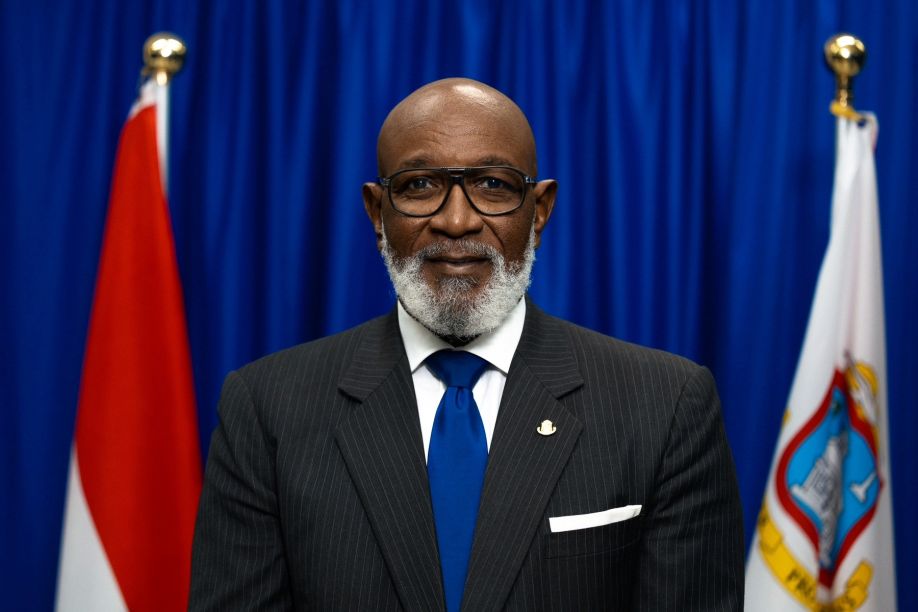
GREAT BAY--Minister of Public Health, Social Development and Labor (VSA) Claret Connor has assured Parliament that families who qualify for government financial assistance will not lose their benefits because of an approximately Cg 1.8 million difference between projected assistance expenditures and the amount allocated in the draft 2027 national budget. The Minister emphasized that financial assistance is a statutory entitlement and that government remains legally obligated to provide support to eligible persons, regardless of the budget projections.
Connor provided the clarification during the continuation of the 2027 national budget debate in response to questions from Member of Parliament Omar Ottley, who challenged government's decision to allocate Cg 8.2 million for financial assistance despite indications that spending could reach approximately Cg 10 million.
The Minister rejected the suggestion that the difference, described in Parliament in rounded terms as approximately Cg 2 million, meant families would automatically be removed from assistance or that benefits would be reduced by that amount.
"The 2 million difference should not be read as 2 million in aid being withdrawn or as a set number of families being removed from assistance," Connor told Parliament.
He explained that the Cg 8.2 million allocation was established using expenditure estimates available when the 2027 budget was prepared. However, financial assistance costs began increasing during the latter part of 2026, resulting in higher projected requirements.
The Ministry had originally sought Cg 12 million for financial assistance in 2027, but the submitted budget contains Cg 8.2 million, a difference of Cg 3.8 million between the requested and allocated amounts. Separately, the estimated Cg 10 million in current spending represents a gap of approximately Cg 1.8 million compared with the 2027 allocation.
Connor described the Cg 8.2 million as the statutory baseline included in the budget, rather than a decision to reduce government's commitment to assisting vulnerable households.
He acknowledged that the potential funding shortfall had been identified as a budgetary risk, but maintained that the Ministry intends to implement measures aimed at limiting the need for additional financial assistance.
While the Minister assured Parliament that eligible recipients would remain entitled to support, he did not identify a specific additional allocation to cover the potential difference should expenditure exceed the amount budgeted.
article continues below...
Approximately Cg 32 Million Directed Toward Vulnerable Households
Responding to criticism that the Ministry appeared more focused on healthcare than social development and poverty relief, Connor disclosed that approximately Cg 32 million in the 2027 budget is directed toward programs and services benefiting vulnerable households.
He explained that public attention has largely centered on major healthcare initiatives, including General Health Insurance, mental healthcare reform and construction of the St. Maarten General Hospital. However, he insisted that social assistance remains a priority within VSA.
The approximately Cg 32 million covers a broader range of services than direct financial assistance alone. These include financial aid, medical assistance, healthy food and poverty-related initiatives, subsidized services for vulnerable groups, employment support through the National Employment Services Center (NESC), and development of the Social Registry.
The Minister's explanation sought to demonstrate that government's social support activities extend beyond monthly financial assistance payments and include measures intended to improve household stability, employment opportunities and access to essential services.
He also emphasized that VSA is working to strengthen its social services infrastructure to identify vulnerable residents earlier and provide more coordinated assistance.
Government Wants to Reduce Dependence on Financial Aid
Connor outlined several initiatives intended to help residents improve their circumstances and reduce their long-term reliance on government assistance.
These include continued development of employment services through the NESC job portal, follow-up activities connected to a recently organized job fair, additional empowerment programs and collaboration with other ministries on initiatives to improve household livelihoods.
The Minister explained that the objective is to equip individuals with skills, employment opportunities and other forms of support that could help them become less dependent on direct government financial aid.
The approach is also intended to limit pressure on future social assistance budgets, although Connor did not provide a projected financial saving or an estimate of how many recipients could move off assistance through these initiatives.
The Ministry is also introducing an application and website intended to simplify access to social assistance and reduce the time required to respond to applications.
Additional measures include improved professional training for social workers and greater use of information from the Household Expenditure Survey to guide assistance decisions.
Connor identified at-risk families, elderly residents, persons with disabilities and families affected by domestic violence as groups requiring particular attention through the strengthened social services system.
Social Registry to Expand in 2027
Another significant part of the Ministry's social assistance strategy is the development of the Social Registry, which is intended to improve the identification of vulnerable households and connect them with appropriate services.
Connor reported that approximately 1,200 households, representing more than 2,000 individuals, were registered during the 2026 pilot.
The initiative is expected to move into structured implementation in 2027.
According to the Minister, its effectiveness will be evaluated through registration and referral rates, the number of households successfully receiving assistance, the time between identification and the delivery of support, and its ability to reach vulnerable households during emergencies and disasters.
The system is intended to provide government with a clearer picture of household needs and improve coordination among the agencies responsible for social assistance.
GEBE Relief Program Entirely Financed by Utility
Connor also provided clarification on the electricity relief initiative administered through VSA, confirming that the announced Cg 400,000 allocation is financed entirely by NV GEBE.
Government does not contribute financially to that allocation, he explained. Instead, the Department of Labor Affairs and Social Services administers the initiative, while VSA provides oversight.
The clarification followed questions from MP Ottley concerning whether government intended to match GEBE's financial contribution.
Connor said the relief program uses the eligibility criteria established under the National Ordinance on Financial Aid, with assistance directed toward individuals who cannot adequately meet their basic needs.
Two categories may qualify: persons already receiving government financial assistance and new applicants whose household circumstances meet the eligibility requirements.
Working families and single-income households may therefore qualify for electricity relief, provided their income and overall financial circumstances satisfy the applicable criteria.
Eligibility is not determined solely by the size of an electricity bill.
The Minister clarified that small businesses do not qualify because the initiative is intended for residential households. However, self-employed individuals may qualify based on their personal household circumstances.
He also explained that tenants whose electricity accounts remain registered in their landlords' names are not eligible under that arrangement until the accounts are transferred into their own names. The renewed relief program includes assistance to help eligible tenants complete that transition.
The arrangement also provides for assisting vulnerable households with outstanding electricity arrears and payment arrangements.
Connor disclosed that only one application for GEBE relief had been denied, explaining that the applicant was assessed as having sufficient financial means under the applicable ordinance.
He did not provide the total number of applications received or households approved during that response.
Quarterly Reports on GEBE Assistance Promised
The Minister further announced that government intends to publish quarterly reports on the administration of the electricity relief initiative, beginning with figures from January 2027.
The reports will identify the amount allocated and utilized, the number of households receiving assistance, the number of applications received, approved and denied, and the remaining available balance.
The information will be presented in aggregate form to protect beneficiaries' privacy.
During the clarification round, Ottley again questioned government's decision not to contribute financially to the GEBE relief allocation.
He announced his intention to introduce a budget amendment that would provide government funding to assist households, arguing that social relief should not depend solely on the utility company's contribution.
No government matching allocation was confirmed during Connor's response.
Home Repair Assistance Concluded After More Than 100 Homes
Connor also addressed questions concerning the home repair initiative administered through the Department of Community Development, Family and Humanitarian Affairs.
The department's budget amounted to approximately Cg 740,000 in 2025 and Cg 955,000 in 2026, covering home repairs and other empowerment activities.
The home repair initiative, originally established following Hurricane Irma, accounted for most of the department's 2026 allocation.
According to the Minister, more than 100 homes benefited from work ranging from smaller repairs involving materials and labor to major roof repairs over the two-year period.
The program concluded during the second quarter of 2026.
Join Our Community Today
Subscribe to our mailing list to be the first to receive
breaking news, updates, and more.