


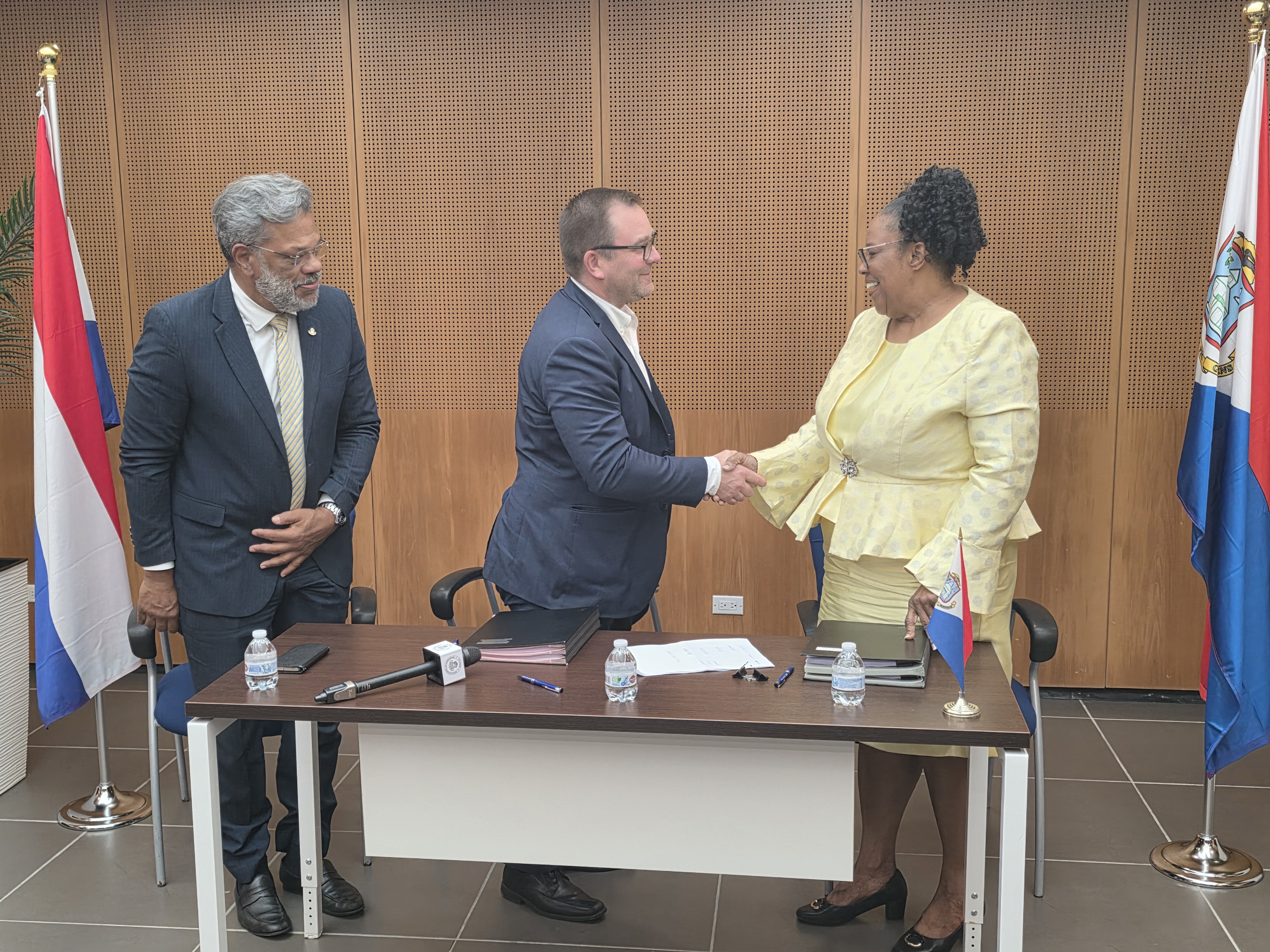
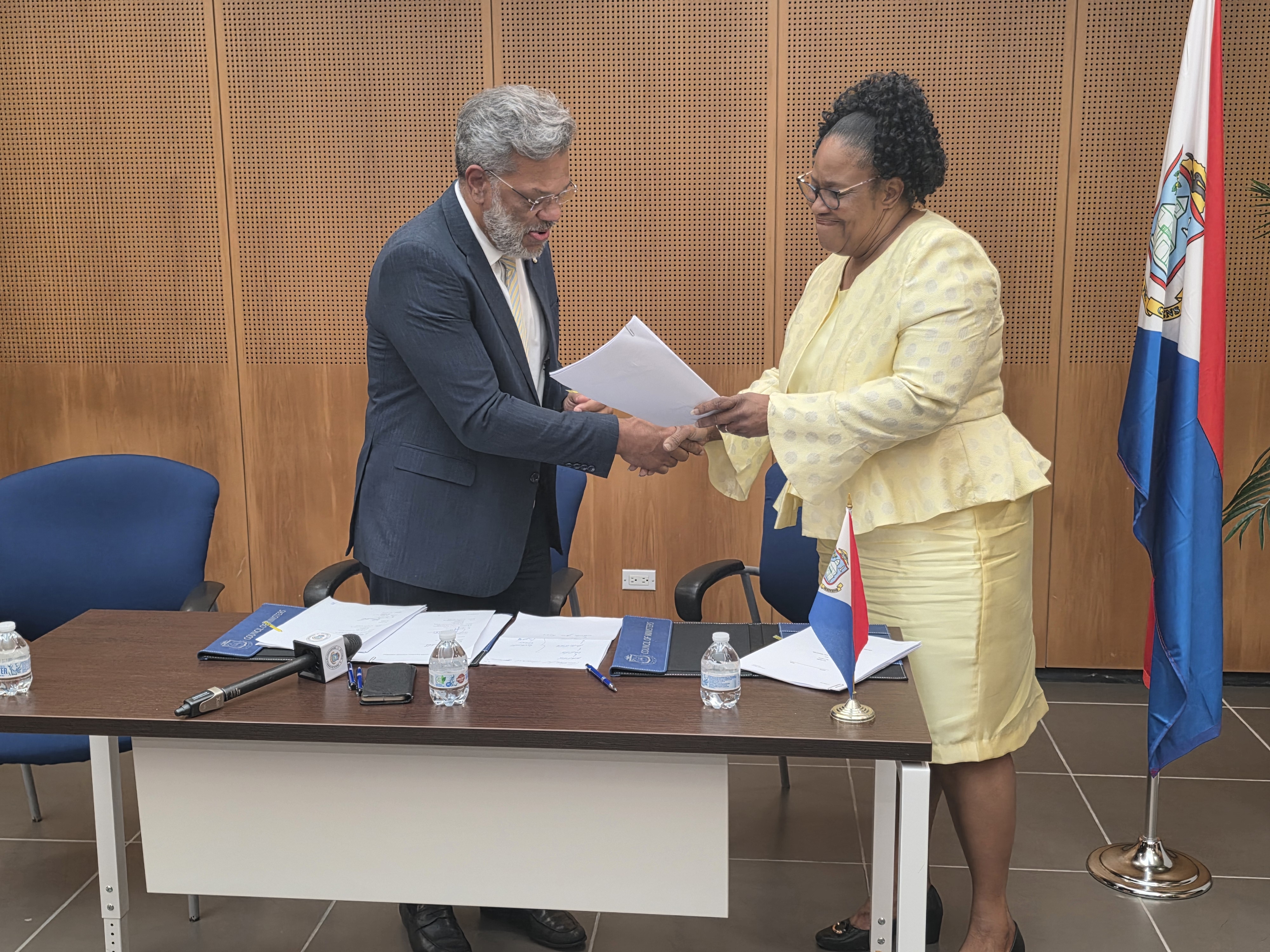
GREAT BAY--St. Maarten's long-awaited investment in three new Wärtsilä generators is expected to reach commissioning in 2028, following the signing of agreements on Wednesday, November 4, that will pave the way for an investment exceeding US$70 million in the country's electricity generation infrastructure.
Prime Minister Dr. Luc Mercelina and NV GEBE Temporary Manager Iris Arrindell outlined the significance of the project during the signing ceremony, describing it as a major step toward addressing the country's aging electricity infrastructure and establishing a more reliable power supply.
The project involves the acquisition and installation of three new Wärtsilä generators, each capable of producing 9.3 megawatts, providing a combined generation capacity of 27.9 megawatts once fully commissioned. The engines are expected to have an operational lifespan of approximately 25 years.
According to Arrindell, GEBE is targeting June 1, 2027, for the start of the installation and construction phase at its power plant, with commissioning anticipated approximately 14 months later, placing the expected completion in 2028. The exact commencement date will be finalized through further discussions with Wärtsilä.
The project will require extensive preparatory work, including the demolition of GEBE's existing power buildings one and two, relocation of an access road and preparation of a new site to accommodate the generators. Arrindell confirmed that some preparatory activities are already underway.
The agreements signed with Wärtsilä cover two major components of the project. The offshore contract provides for the manufacturing of the equipment in Finland, while the onshore contract covers construction, installation, testing and commissioning in St. Maarten. Wärtsilä will remain responsible for the installation process until the generators have been tested, commissioned and formally handed over to GEBE.
From Electricity Stability to Reliability
During the ceremony, Mercelina reflected on the electricity crisis that confronted his administration in 2024, when a national blackout and subsequent load shedding exposed the vulnerability of the country's generation capacity.
The Prime Minister explained that government's initial priority was to stabilize the electricity supply through the introduction of temporary containerized generators. With that emergency intervention having improved conditions, the focus has now shifted toward establishing long-term reliability.
"We were in instability, we worked towards stability. Today we're going to work towards the reliability of energy," Mercelina said.
He emphasized that insufficient electricity generation threatens economic activity, livelihoods and national security, making investment in permanent generation capacity essential to the country's development.
Mercelina also outlined government's longer-term energy objectives, identifying affordability and the introduction of renewable energy as subsequent priorities.
While acknowledging concerns that additional fossil fuel generators could appear inconsistent with the transition toward cleaner energy, the Prime Minister argued that St. Maarten must first address weaknesses in its existing infrastructure before it can successfully expand into alternative energy sources.
He said the intention is to eventually combine dependable conventional generation with renewable energy to establish a more sustainable electricity system.
Government and GEBE Share Investment Costs
Arrindell explained that the project is being co-financed by the Government of St. Maarten and GEBE, with the government financing two of the generators and GEBE financing the third.
Under the financial arrangement, GEBE will sell two generators to government, which will subsequently lease them back to the utility. This structure will allow the equipment to be properly accounted for in connection with financing obtained through a loan arrangement with the Netherlands.
The overall investment exceeds US$70 million, with a significant portion of GEBE's financial commitment directed toward the infrastructure and civil works required to accommodate the new equipment.
Mercelina thanked the Dutch government for its financial assistance, noting that securing the necessary resources had been a major challenge given St. Maarten's competing financial obligations.
Arrindell acknowledged that the investment was long overdue, explaining that GEBE's aging infrastructure has required substantial upgrades for years. However, the utility's previous financial and organizational challenges had delayed the necessary improvements.
She emphasized that the new generators are essential not only for improving reliability but also for increasing operational efficiency.
GEBE currently experiences peak electricity demand of approximately 60 megawatts, particularly during the tourism season. The additional generation capacity is expected to strengthen the utility's ability to meet demand and reduce its dependence on aging equipment.
Local Workers to Participate in Construction
The project will also involve local participation during the construction and installation phases.
Wärtsilä representatives confirmed that a dedicated team will be stationed in St. Maarten throughout the installation period, working alongside GEBE employees and local contractors. The project is also expected to create employment opportunities for local workers involved in the civil works and related construction activities.
GEBE and Wärtsilä will each assign project managers to oversee implementation and coordinate the various construction, installation and technical activities.
Once the generators have been installed, the project will move through a series of inspections, pre-commissioning checks and operational tests before final commissioning.
Wärtsilä representatives explained that testing will be coordinated with GEBE's existing generation operations to avoid interruptions to the public electricity supply. The new equipment will undergo checks to ensure that its systems function properly before being integrated into regular operations.
Government Emphasizes Long-Term Energy Strategy
Mercelina praised Arrindell for her leadership in advancing the generator acquisition, acknowledging her persistence and commitment throughout the negotiations. He also recognized the contributions of GEBE's Supervisory Board, employees and the technical teams involved.
The Prime Minister additionally highlighted the involvement of Minister of Tourism, Economic Affairs, Traffic and Telecommunication Grisha Heyliger-Marten in advancing legislation for the regulation of electricity and water tariffs, as well as the role of Minister of Public Housing, Spatial Planning, Environment and Infrastructure Patrice Gumbs in the utility's concession framework.
The signing represents the beginning of a major implementation phase rather than the immediate availability of additional electricity. Significant construction, equipment manufacturing, installation and testing must still take place before the generators can enter service.
With commissioning targeted for 2028, government and GEBE are seeking to establish sufficient permanent generation capacity to support economic activity, meet future electricity demand and strengthen the long-term reliability of St. Maarten's power supply.
Join Our Community Today
Subscribe to our mailing list to be the first to receive
breaking news, updates, and more.