.jpg)


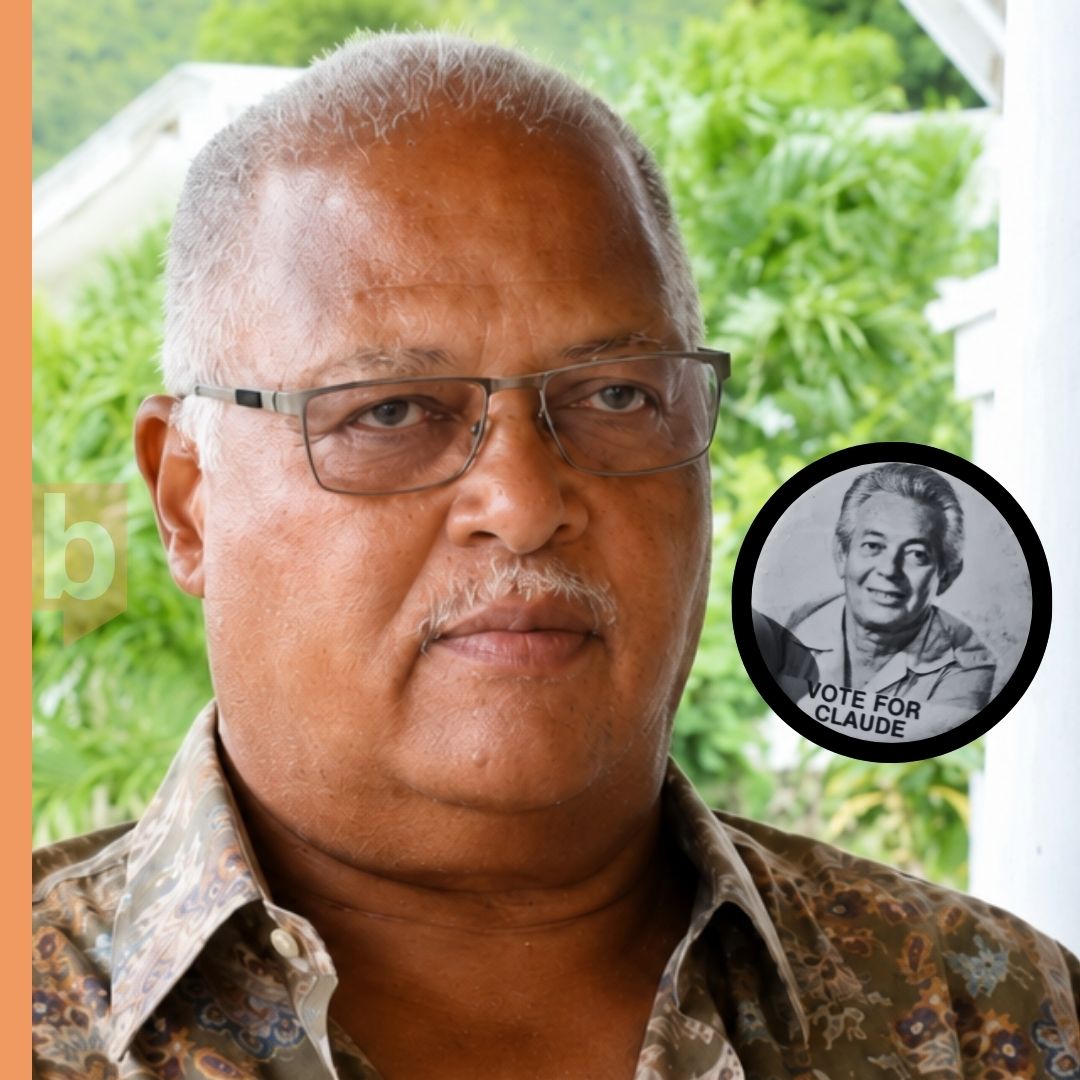
GREAT BAY--Former Commissioner and longtime Democratic Party member Rene Richardson has credited the late Claude Wathey with helping to shape his education, career and political life, while describing the former political leader as a man whose vision was matched by empathy, determination and action.
Speaking during a recent radio discussion about Wathey’s legacy, Richardson said he worked closely with the former leader and felt compelled to contribute because many people now claim an association with Wathey without having been directly involved in his work.
Richardson said his relationship with Wathey began when he was still a young student. Wathey and Clem Labega were instrumental in arranging for him to attend Radulphus College in Curaçao before he continued his studies in the Netherlands. Wathey knew Richardson’s mother from French Quarter and remained in contact with him during his student years.
After Richardson returned to St. Maarten, Wathey also assisted him in obtaining employment at Mullet Bay. That support later developed into a working relationship as Richardson became involved in the labor movement and established the Windward Islands Federation of Labor.
Richardson said the major hotels and businesses operating at the time were resistant to organized labor and wanted to determine working conditions without union involvement. He recalled disputes over pooled service-charge funds, which he maintained belonged to workers and should not be controlled or spent by hotel management.
According to Richardson, Wathey played an important role in securing the legislation that established formal recognition of workers’ representation. That framework allowed employees seeking union representation to approach the government mediator and participate in a referendum to determine which organization would represent them.
Richardson described the legislation as a critical development for the labor movement and said it strengthened his ability to organize workers throughout St. Maarten.
“Because of Claude, I am what I am today,” Richardson said while reflecting on Wathey’s contribution to his professional development and the establishment of organized labor.
Richardson also recalled approaching Wathey about securing land for a permanent union building, explaining that workers needed a headquarters and an identity. Wathey instructed him to prepare the request and work with the relevant land-registration officials. Richardson said the WIFOL building that exists today resulted from that process.
Wathey also ensured that the labor movement was included in wider constitutional discussions, Richardson said. During preparations for a Round Table Conference in the early 1980s, Wathey insisted that workers be represented and appointed Richardson as an adviser, although he was not yet serving in government. Richardson accompanied Wathey to the Netherlands and recalled that officials from Curaçao questioned how Wathey had decided to include a trade union representative.
Wathey’s response, Richardson recalled, was direct: “The workers must be represented.”
Richardson said Wathey had previously selected him to accompany a delegation to New York around 1979 or 1980 when Mullet Bay was facing difficulties involving apartment owners. He said the decision demonstrated Wathey’s willingness to include people with relevant knowledge, even when they did not hold elected office or a government position.

Richardson formally joined the Democratic Party in 1983 after a private meeting with Wathey at the Point Blanche home of Richardson’s cousin. According to Richardson, his cousin, Mr. Beauperthuy, arranged for the two men to meet alone and discuss his political future. During the 1983 election, Richardson appeared as the fifth candidate on the Democratic Party list and received close to 500 votes, the second-highest total after Wathey.
Despite his result, Richardson said he advised Wathey to retain Commissioners Julian Connor and Sam Hazel. He preferred to continue his work in the private sector and with the labor movement rather than immediately seek appointment as a Commissioner.
Richardson entered government in 1985 when Wathey later called on him and Joseph Richardson to serve. Richardson eventually served 12 years in the Island Council and said he was always elected through preferential votes. After first appearing as candidate number five, he later contested elections as candidate number three.
Beyond politics and labor, Richardson described Wathey as approachable and willing to assist people in need. He recalled walking with Wathey near the Parliament building in Curaçao, where several men would approach him for financial assistance. Wathey knew them and regularly assisted them financially Richardson said, stressing that the assistance had nothing to do with purchasing political support because the men were not St. Maarten voters. Richardson said the encounters demonstrated Wathey’s personal concern for people and his willingness to help without making the assistance public.
Richardson said Wathey understood that leadership required more than identifying a problem or presenting an idea. “You can’t have vision without action,” Richardson said. “Claude had a vision, but the man was determined to get that vision executed and implemented.”
Richardson said this approach was also visible in Wathey and Clem Labega’s efforts to establish tourism as the foundation of St. Maarten’s economy. He recalled accounts of the two men traveling to New York, using their own funds and sharing limited accommodations while meeting potential investors and promoting St. Maarten as a tourism destination.
Richardson argued that Wathey and Labega selected tourism at a time when it represented a much smaller portion of the international economy. He said their decision should be understood in the context of the early 1960s, when the industry had not yet reached its present global importance.
While acknowledging that mistakes were made during St. Maarten’s development, Richardson said people who take action will inevitably face criticism. He argued that Wathey and Labega deserve recognition for pursuing an industry that later became the main economic pillar of the country.
“You are there because of the old school,” Richardson said, rejecting attempts to dismiss the contribution of earlier generations of political leaders.
Richardson also recalled Wathey’s belief that political leadership must be built around people. He said Wathey compared society to a house and told Richardson that a structure without a strong foundation would eventually fall apart. According to Richardson, Wathey identified the people as the foundation of every society and repeatedly advised him to take care of them. Richardson said that focus on people is increasingly missing from modern politics.
Education was another central part of Wathey’s outlook, Richardson said. He recalled Wathey explaining that an educated person would be better equipped to become self-reliant, find employment and demand fair treatment, rather than being forced to move between temporary jobs or depend continually on assistance.
Richardson said Wathey’s legacy cannot be reduced to political slogans or selective accounts of his time in office. He described him as a leader who supported education, strengthened workers’ representation, encouraged investment, assisted individuals and acted on his plans.
For Richardson, Wathey’s central lesson was that leadership required a strong connection to the people, the courage to make decisions and the discipline to move from ideas to implementation.
Join Our Community Today
Subscribe to our mailing list to be the first to receive
breaking news, updates, and more.