





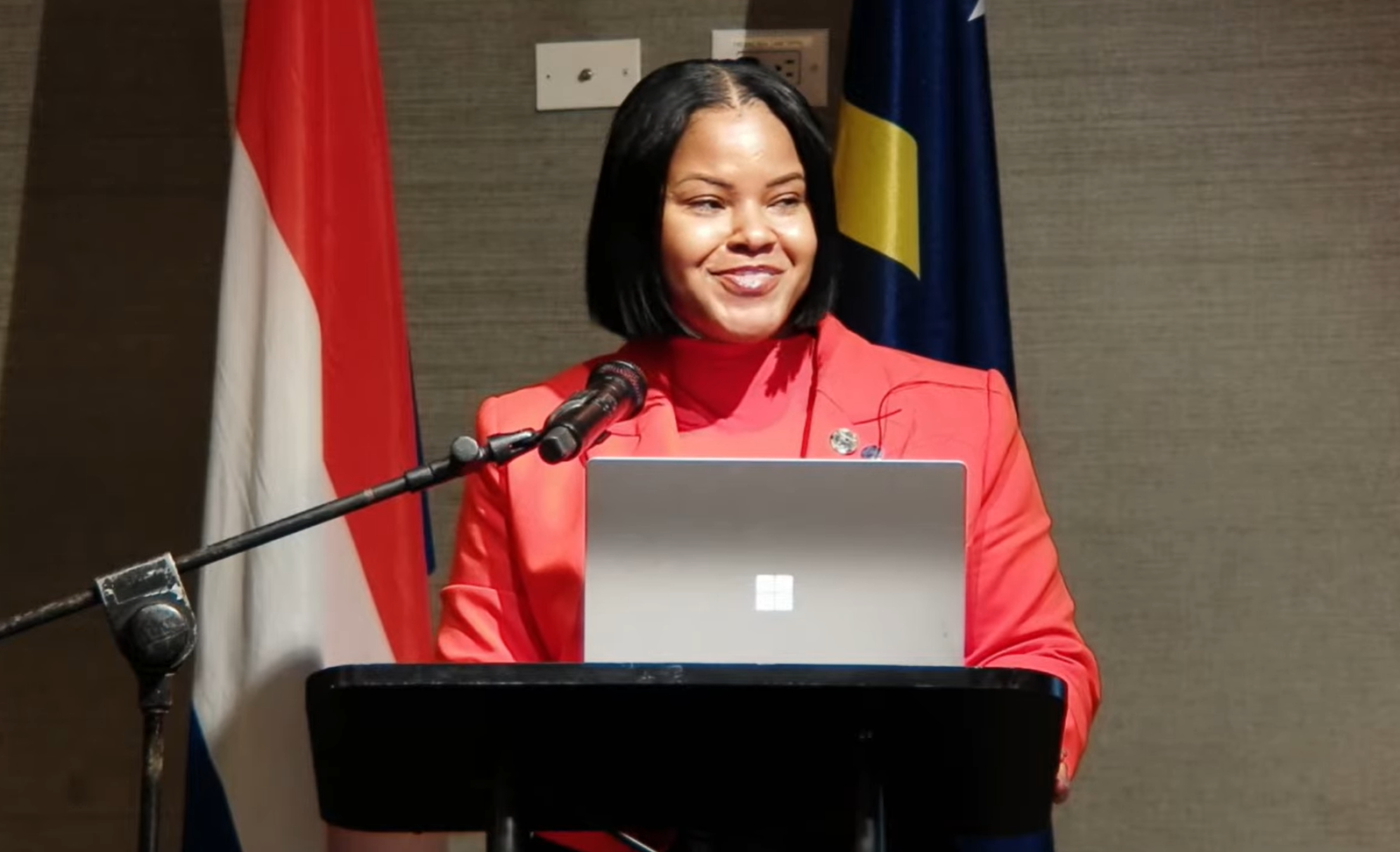
ORANJESTAD, Aruba--In an appeal delivered during her country update at the Interparliamentary Kingdom Consultations (IPKO) in Aruba on Thursday, MP Sjamira Roseburg urged the parliaments of the Kingdom to move beyond viewing Kingdom relations as a set of files to be managed and instead return to direct, honest engagement focused on people and outcomes. Roseburg is the Chairperson of the Committee of Kingdom Affairs and Interparliamentary Relations for St. Maarten.
Speaking in Dutch in the closing portion of her presentation, Roseburg cautioned that when relationships are treated as “dossiers,” leaders risk losing sight of the faces and lives behind the policies. She emphasized that the Kingdom is not a collection of entities in a statute, but four countries, St. Maarten, Aruba, Curaçao and the Netherlands, connected by a shared history and a shared future.
Roseburg’s message was that agreements must be recognized, differences must also be respected, and those differences are not obstacles but the reality of a diverse Kingdom. She called on delegations to stop talking at each other and start talking with each other, to look each other in the eyes, and to have the real conversations, including the uncomfortable ones.
Roseburg said the purpose is not to manage dossiers, but to change lives, the lives of all people within the Kingdom. She closed by stating that she is ready, St. Maarten is ready, and asked whether the entire Kingdom is truly ready.
Continues below...
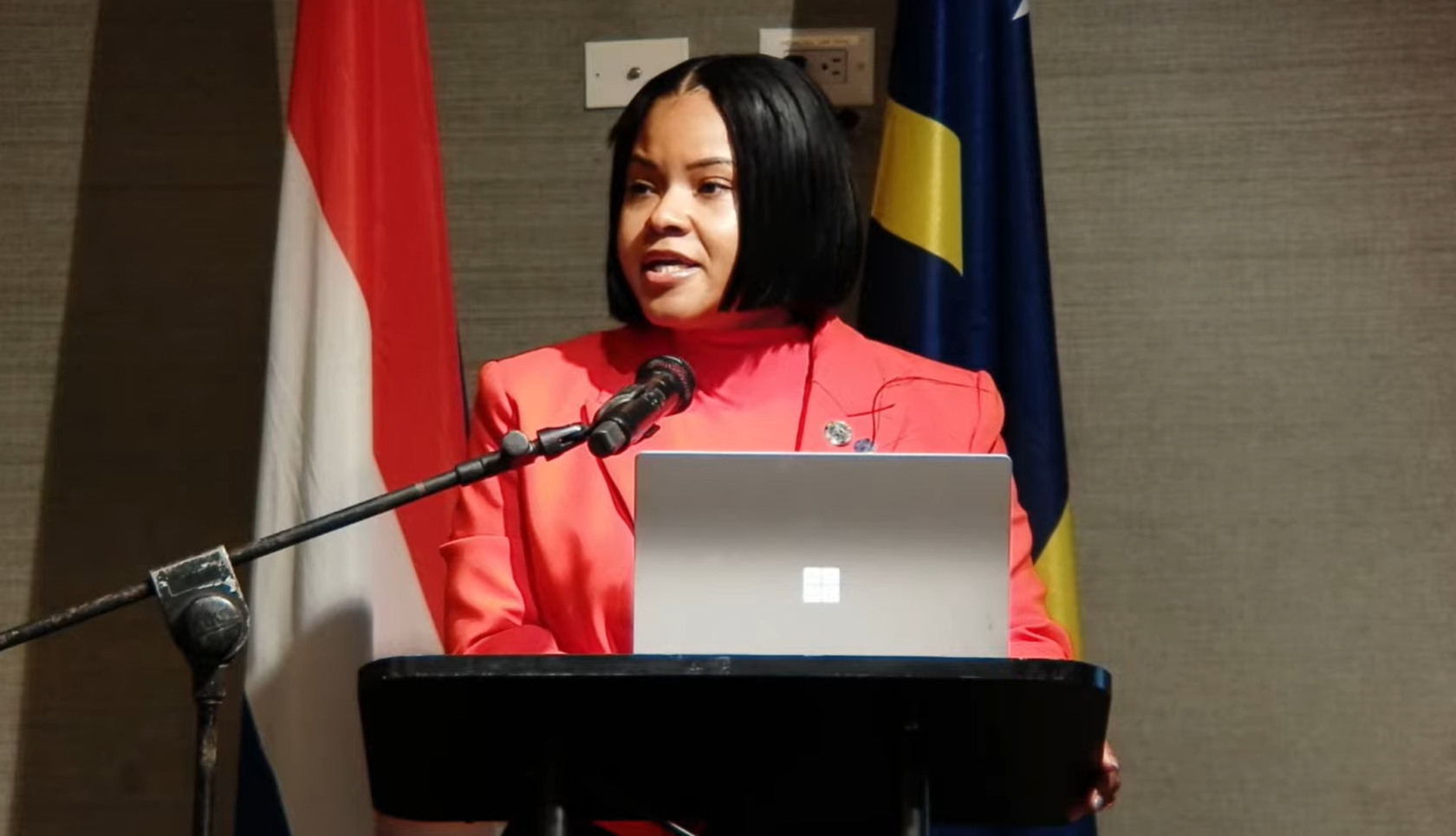
Country update presented on behalf of St. Maarten delegation
Roseburg delivered the update in her capacity as Chairperson of the Committee of Kingdom Affairs and Interparliamentary Relations of the Parliament of St. Maarten. She opened by noting the personal significance of returning to Aruba, the country where her mother was born.
On behalf of the St. Maarten delegation, Roseburg confirmed the delegation participating in the consultations: President of Parliament and delegation leader MP Sarah Wescot-Williams, MP Egbert Doran (National Alliance), MP Viren Kotai (Democratic Party), MP Francisco Lacroes (United People’s Party), MP Lyndon Lewis (National Opportunity Wealth Party), MP Raeyhon Peterson (Party for Progress), the Secretary General of Parliament, and Roseburg representing the Unified Resilience St. Maarten movement.
Parliamentary work and improved institutional coordination
Roseburg stated that Members of Parliament continue to actively use their parliamentary rights and instruments, including written questions and requests, and reported an increase in use of question hour. She explained that questions submitted by Wednesday are handled the following Monday.
She also reported that Parliament’s leadership has drafted a protocol currently being discussed between the Secretariats of Parliament and the Council of Ministers, aimed at ensuring both institutions can function properly within the system.
Basic bank account ordinance, amendments, and deposit limit advocacy
Roseburg reported that on January 9, Parliament approved the National Ordinance on the basic bank account for consumers, together with three amendments. She said an amendment submitted by MP Sarah Wescot-Williams focused on clarifying terminology, while two amendments submitted by MP Ardwell Irion focused on digital maintenance and yearly reporting by banks on the basic bank account.
She further reported that Parliament unanimously adopted a motion submitted by MP Francisco Lacroes to have government formally advocate with the Central Bank of Curaçao and St. Maarten for the maximum monthly deposit limit for basic bank accounts in St. Maarten to be raised to at least 5,400 guilders per month. Roseburg said the motion reflects that while the countries operate within one monetary union, social and economic circumstances differ, and policies must respond to practical realities.
Women’s Caucus reactivated
Roseburg advised that the four female Members of Parliament reactivated the Women’s Caucus as a platform to debate issues related to women and broader policy matters. She said the caucus recently traveled to a conference focused on gender-based violence.
Developments across ministries, education, and culture initiatives
Roseburg stated that the Ministry of General Affairs is discussing a potential extension of the mutual arrangement for the country package and the trust fund, and emphasized that Parliament will keep a close eye on these agreements because of their impact on the country. She also referenced capacity issues within government.
On education, culture, youth and sports, Roseburg said government is focusing on integrating these areas to support holistic development and aligning education outcomes with labor market needs. She referenced efforts to enhance professional development for educators, youth-focused professions, and increased parental involvement. She also cited priorities including resilience, education, and cultural and sports infrastructure through reconstruction, funding and capital investment, and empowering vulnerable youth and professionalizing the workforce through initiatives such as the Fostering Resilient Learning Project and the Child Resilience and Protection Project.
Roseburg also referenced government’s interest in developing national policy on artificial intelligence and STEAM education to support innovation and long-term sustainability.
Slavery past, health impacts, and Kingdom-level dialogue
Roseburg highlighted an acquisition of approximately 5.3 million in grant funding for an Action Agenda project linked to slavery past initiatives. She described it as a multi-year initiative centered on economic self-determination through culture, with focus areas including remembrance, education and healing, and said the work is intended to have long-term impact.
She referenced a November 2025 report cited in her remarks that reconfirmed the history of slavery continues to affect mental and physical health today, particularly among descendants of enslaved people.
In the discussion that followed, Roseburg responded to a question, posed in Dutch, about how the other countries within the Kingdom would be involved. She said other countries also received funding to address slavery past issues and emphasized the need for a holistic approach and a Kingdom-wide conversation. She underscored that if leaders avoid these discussions at forums such as IPKO, it becomes unrealistic to expect the public to have the conversation at home.
Economy, TEATT priorities, and tourism figures cited
On the economic front, Roseburg said the Ministry of TEATT, linked to the country package track, hosted a stakeholder consultation workshop from February 2 through February 6, 2026, aimed at translating input into a strategic economic plan for St. Maarten. She also cited ongoing work on agricultural research and policy revision, fisheries and poultry policy development, the establishment of the St. Maarten Tourism Authority, and finalization of gambling legislation.
Roseburg stated that St. Maarten’s economy is growing steadily and referenced cruise tourism growth from 2024 to 2025. She cited approximately 1.4 million cruise passengers in 2024 with 513 vessel calls, compared with approximately 1.6 million cruise passengers in 2025 with 592 vessel calls. She also stated that total passengers arriving in 2025 amounted to approximately 857,000 visitors, coming from key markets including the United States, Canada, the Netherlands and France.
Justice reform, detention sector changes, and prison milestone
Roseburg stated that the Ministry of Justice is engaged in legislative reform and review, policy development, institutional strengthening, digital transformation, operational enhancement, and measures aimed at improving access to justice.
She highlighted the groundbreaking for the long-awaited new prison, held around the January 2026 APOLLO period, describing it as a milestone. She stated she has advocated for more than a decade for a modern facility aligned with the Nelson Mandela Rules, prioritizing rehabilitation and reintegration.
Roseburg also referenced the launch of a Detention Sector Reform program aimed at creating a detention system that balances structure, accountability and humanity, with rehabilitation and reintegration, and meeting international human rights standards which is important for the Dutch Kingdom.
Health, labor, and social development updates
Roseburg stated that government is working on establishing general health insurance to provide equal care for all insured residents and strengthen long-term stability.
She referenced inspectorate strengthening efforts focused on modernizing legislation, improving governance, enhancing supervisory capacity, and strengthening protections for workers, patients and vulnerable groups. She also cited the Healthcare Professional Registry as a step intended to regulate healthcare providers and improve patient safety.
Roseburg highlighted mental health efforts, including a two-year cooperation agreement for legal support for persons under involuntary mental health admission, which she said guarantees government-funded legal assistance from the moment a person’s freedom is restricted for mental health reasons, describing early access to a lawyer as a core legal safeguard.
She also referenced elderly care developments and said that following the 2025 Aging with Dignity Conference, a National Healthy Aging Roadmap is being developed with regional partners such as PAHO, with focus on proactive outreach to vulnerable groups.
Country package extension and capacity constraints
Roseburg said St. Maarten is nearing the end of the current mutual arrangement underpinning the country package, and stated that government has concluded St. Maarten would benefit from an extension and clear prioritization of activities to realize lasting reforms.
She emphasized that financial resources are not the main constraint. She identified absorption capacity, the ability of the public sector to make the best possible use of opportunities under the mutual arrangement, as the primary constraint, and said capacity limitations were identified from the start. She called for partners to adapt approaches to ensure maximum results from prioritized activities.
Debt, budget rights, and oversight concerns
Roseburg stated that St. Maarten’s current debt stands at approximately 1.1 billion, citing a government update from September 2025 and linking the issue to the fiscal reality tied to the RFT law.
She also referenced a parliamentary motion, previously raised at IPKO, urging the Council of Ministers to ensure Parliament’s constitutional right to establish the country’s budget is not compromised, and calling for government to examine limiting the role of the CFT to its original intention. She said the motion also resolves to initiate discussion with the Netherlands regarding the Kingdom law governing the CFT and its relevance today, with the possibility of reforms.
Join Our Community Today
Subscribe to our mailing list to be the first to receive
breaking news, updates, and more.
