.jpg)


THE HAGUE--The parliamentary delegations of St. Maarten, Aruba and Curaçao have issued a joint resolution expressing strong disagreement with the Kingdom of the Netherlands’ decision to abstain from voting on a United Nations resolution concerning slavery and the trans-Atlantic trafficking of enslaved Africans.
The resolution was reached during the Tripartite Consultation held in The Hague on June 4, 2026, by the standing committees responsible for Kingdom Affairs, Interparliamentary Relations and Foreign Relations of the Parliaments of Aruba, Curaçao and St. Maarten.
The matter was formally presented during the Interparliamentary Kingdom Consultation, IPKO, which commenced in The Hague on June 5, 2026. The three delegations, through their Presidents of Parliament, Mrs. Sarah Wescot-Williams of St. Maarten, Mr. Alfred Sneek of Aruba and Mr. Fergino Brownbill of Curaçao, presented the resolution to the delegation of the States-General of the Netherlands, representing the First and Second Chambers.
At the center of the resolution is the United Nations vote of March 25, 2026, on a resolution recognizing slavery and the trans-Atlantic trafficking of enslaved Africans as one of the gravest crimes against humanity. The Kingdom of the Netherlands abstained from that vote.
article continues below...
The Caribbean parliamentary delegations stated that they could not support the position taken by the Kingdom, especially given the direct historical, social and moral significance of the subject to the Caribbean countries within the Kingdom.
According to the resolution, official communication from the governments of Aruba, Curaçao and St. Maarten shows that none of the Caribbean countries was consulted beforehand, despite the fact that the matter directly affects their history, identity and present-day societies.
The delegations said this lack of consultation points once again to a structural democratic deficit within the Kingdom, particularly in the area of foreign affairs. Although foreign affairs are handled as a Kingdom matter, the delegations stressed that positions taken internationally can directly affect the Caribbean countries and their people.
The resolution states that the failure to consult the Caribbean countries bypassed the statutory obligation for active consultation and consensus-building. It further notes that the Charter for the Kingdom of the Netherlands is based on equality among the countries, shared responsibility in Kingdom matters and respect for each country’s historical and cultural context.
The delegations also highlighted that the Caribbean countries have been working intensively and structurally on awareness, education, heritage, research, commemoration and social healing related to the history of slavery. These efforts include action agendas, national committees, cultural projects, archival access, educational programs and international cooperation.
In the resolution, the three delegations jointly declare that they cannot agree with the Kingdom’s position on the UN resolution. They also state that it is unacceptable for the Kingdom to take international positions without prior, timely and substantive consultation with the Caribbean countries, particularly on matters that directly touch their history, identity and society.
The resolution calls for the Caribbean countries to receive a meaningful and structural role in the preparation of Kingdom positions related to human rights, historical responsibility and international decision-making. It also calls for timely and binding consultation from the earliest phase of such processes.
The delegations emphasized the guiding principle: “no decisions about our past, without our voice in the present.”
They stated that this principle should apply both at the diplomatic level and in the organization, management and local execution of restoration policies and related funds.
The three delegations have requested that the Dutch States-General delegation participating in IPKO bring the resolution to the attention of the Kingdom Government. They are also requesting that the Kingdom Government provide a written and motivated response within three months, including a concrete proposal to restore consultation procedures.
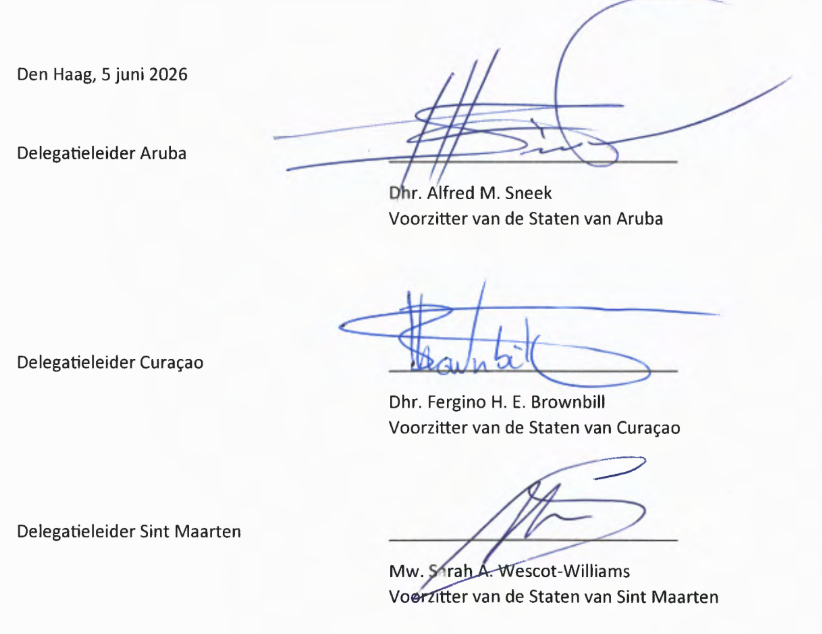
The resolution was signed in The Hague on June 5, 2026, by Mr. Alfred M. Sneek, delegation leader for Aruba and President of the Parliament of Aruba; Mr. Fergino H. E. Brownbill, delegation leader for Curaçao and President of the Parliament of Curaçao; and Mrs. Sarah Wescot-Williams, delegation leader for St. Maarten and President of the Parliament of St. Maarten.
Join Our Community Today
Subscribe to our mailing list to be the first to receive
breaking news, updates, and more.