


GREAT BAY--The 2025 Annual Report of the St. Maarten Reconstruction, Recovery and Resilience Trust Fund highlights major progress across the country, with investments delivering visible results in infrastructure, healthcare, education, small business development, digital government, waste management and disaster preparedness.
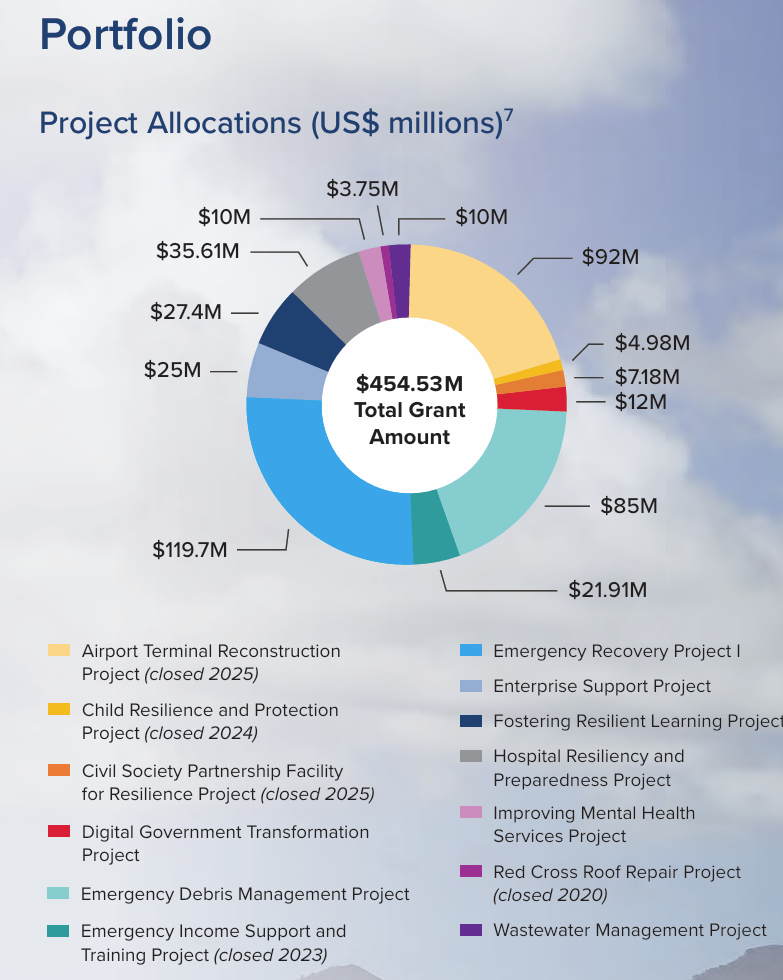
Now in its eighth year, the Trust Fund has moved from emergency recovery into a more focused phase centered on long-term resilience, stronger public systems and government-led sustainability. According to the report, the Trust Fund portfolio consisted of 13 projects as of December 31, 2025, including eight active projects and five closed projects. Total cumulative grant commitments reached US$501.60 million, with US$330.02 million disbursed by the end of 2025.
One of the most significant milestones was the completion of the Princess Juliana International Airport Terminal Reconstruction Project, which closed in June 2025. The report describes the fully restored and upgraded airport as a visible symbol of St. Maarten’s recovery, with the terminal restored to pre-Hurricane Irma passenger capacity and strengthened with improved hurricane resilience. Passenger traffic increased from 1.6 million in 2024 to approximately 1.8 million in 2025, reflecting renewed connectivity and economic momentum.
The report also points to strong support for local entrepreneurs. Through the Enterprise Support Project, 321 micro, small and medium enterprises received approximately US$20 million in financing packages to invest in and expand their operations. Of these businesses, 43 percent were owned or managed by women. In addition, 374 entrepreneurs participated in training in business fundamentals, helping to strengthen private sector resilience and job creation.
Healthcare investments also showed measurable results. Construction of the new St. Maarten General Hospital advanced significantly in 2025, while upgrades to the existing St. Maarten Medical Center improved patient care in the short term. The report notes that overseas medical referrals were reduced by 88 percent, while patient satisfaction rose to 85 percent, a 25 percent increase compared to three years earlier. A 10-year mental health vision and strategic plan was also drafted for government review.
In education, the Fostering Resilient Learning Project continued to support reforms through national learning assessments and infrastructure work. The second national learning assessment was conducted in June 2025, measuring reading and mathematics across public and subsidized primary schools. Demolition work also cleared the way for upgraded primary schools and a new main library.
Community resilience remained a major area of impact. The Civil Society Partnership Facility for Resilience Project, known as R4CR, closed in March 2025 after supporting 91 community subprojects that directly benefited 20,365 people. The project also strengthened 58 local civil society organizations, improving their ability to deliver programs for children, youth, vulnerable families, seniors and communities across the island.
The report also highlights progress in waste management, sanitation and environmental protection. All people affected by planned activities at the solid waste disposal site were relocated, creating a buffer zone to protect nearby communities and support future landfill upgrades. A new weighbridge was installed at the landfill to measure incoming waste and provide data for a more efficient waste management system. Under the Wastewater Management Project, work also advanced to rehabilitate and upgrade the A.T. Illidge Wastewater Treatment Plant, with future sewerage connections expected to benefit about 8,400 residents in the Cul de Sac area.
Digital government reforms also moved forward. Three government departments were digitally connected through a secure network, 65,000 public paper records were digitized and validated, and 400 civil servants received cybersecurity training. The report says progress continued on a national e-ID, e-signature and Single Sign-On system, all aimed at improving access to public services for citizens and businesses.
Disaster preparedness also improved in 2025. Approximately 17.6 kilometers of electricity distribution lines were placed underground to reduce vulnerability during storms, benefiting about 1,400 households. A new Cell Broadcast System was successfully field tested and is expected to support direct-to-mobile emergency alerts before the 2026 hurricane season.
The Trust Fund’s 2025 to 2028 Strategic Framework was endorsed in June 2025, marking a shift toward institutional capacity, sustainability and national ownership. In December 2025, the World Bank approved the Sustaining Program Effectiveness and Advancing Resilience Project, known as SPEAR, to help strengthen public systems, maintain implementation capacity and support the creation of a Disaster Reserve Fund.
Looking ahead to 2026, implementation priorities will focus on health, education, urban services, digital government and resilience. Major activities include advancing the new mental health facility, continued work on the new general hospital, school gym and sports facility upgrades, expanded sewerage coverage, landfill procurement, and the completion of key digital reforms.
The report concludes that the Trust Fund’s next phase will be defined by transition, institutional handover and ensuring that St. Maarten has the systems, skills and public capacity to sustain recovery gains beyond the life of the program.
Source: St. Maarten Reconstruction, Recovery and Resilience Trust Fund Annual Report 2025.
Join Our Community Today
Subscribe to our mailing list to be the first to receive
breaking news, updates, and more.