Above the traffic: An exclusive look Inside the Swift Rails proposal submitted to Govt
.jpg)
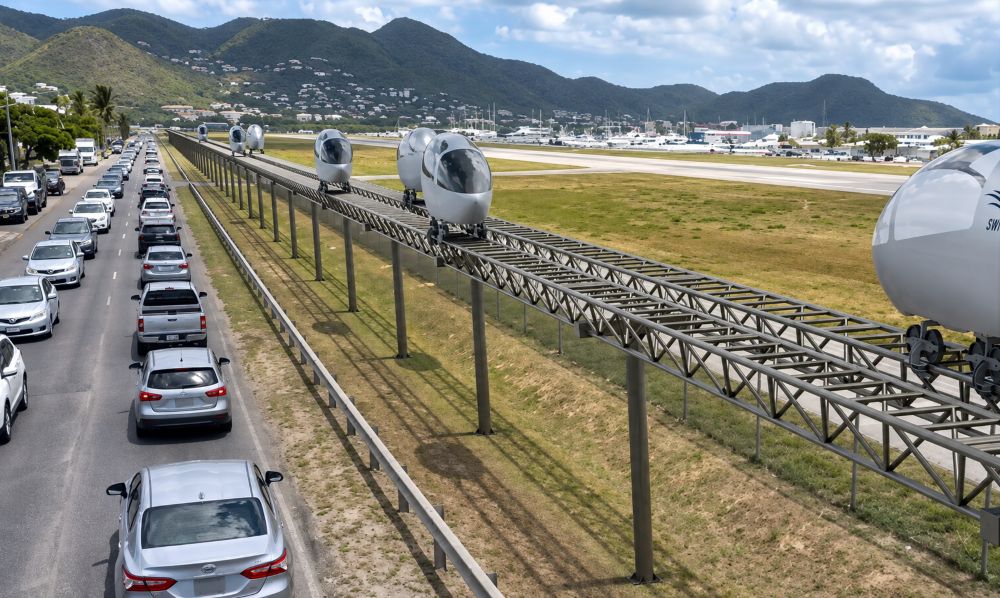
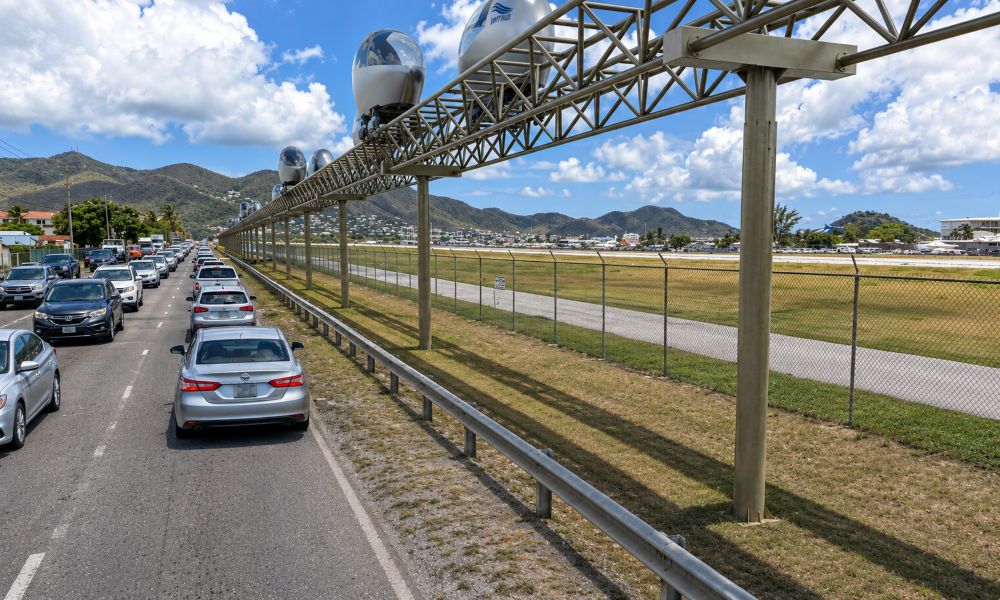
Imagine landing at Princess Juliana International Airport, walking to a small station, stepping into a two-or-four-person electric vehicle and travelling above the traffic instead of joining it. The vehicle heads toward Maho, continues through Simpson Bay and reaches Pelican Key without sitting through the congestion that can turn a relatively short distance into an hour-long journey.
That is the idea Swift Rails has now formally placed before the Government of St. Maarten.
The proposal is not an approved Government project, and no decision has been made to build it. Swift Rails submitted its concept following a Request for Information, RFI, from the Ministry of TEATT seeking proposals that could help address St. Maarten’s worsening traffic situation. Company representatives confirmed during an interview with The People’s Tribune that their RFI response was recently submitted.
What makes the proposal worth examining is not simply that it looks futuristic. It attempts to answer several of St. Maarten’s most difficult transportation questions at once: how to add transportation capacity when there is little room to widen roads, how to move residents and visitors more predictably, how to do it without requiring a major Government capital contribution, and whether transportation itself could become another part of the island’s tourism product.
So the first question is obvious: How would it actually work?
Swift Rails describes its concept as an elevated, on-demand, semi-autonomous transportation system.
Instead of traditional trains carrying dozens or hundreds of passengers according to a fixed timetable, smaller electric vehicles would travel along an elevated track. CEO Kevin Neumaier said the vehicles could accommodate one, two or four passengers, although the initial system would rely primarily on two-person units.
Passengers could request a vehicle in advance or simply arrive at a station, enter, select their destination and travel directly to their stop. Although much of the technology would operate autonomously, Neumaier said human oversight would remain for safety and customer service.
The proposed first phase would connect the airport with Maho, Simpson Bay and Pelican Key.
That corridor is no accident. It contains the airport, major hotels, large employment centres and some of the island’s most persistent congestion. It would therefore serve tourists arriving with luggage, hotel employees travelling to work, residents moving between communities and businesses dependent on predictable travel times.
The company estimates the entire roughly eight-kilometre trip from the airport to Pelican Key at approximately five minutes. Those numbers remain projections and would have to be confirmed through technical and feasibility studies.
article continues below...

Why go above the road?
This may be the most interesting part of the concept for St. Maarten.
Traditional solutions usually involve widening roads, constructing additional lanes or creating new road corridors. Each becomes difficult on an island where development, hillsides, businesses and private property already compete for limited space. Swift Rails proposes going above that problem.
Neumaier said the elevated system requires relatively small supports, comparing their footprint to something closer to a light pole than another road lane. The company argues that this makes its technology particularly suited to St. Maarten because the transportation capacity could be increased without acquiring the amount of land that another full roadway would require.
That does not eliminate questions about rights of way, station locations, construction impacts or where supports could physically be installed. Those are precisely the matters that would have to be determined during detailed planning.
A US$30 to US$35 million first phase
Neumaier estimated the first phase at approximately US$30 million to US$35 million.
According to the company, Government would not be expected to provide the capital to construct the system. Swift Rails proposes a public-private partnership financed by private investment, with the system generating revenue from passenger fares and potentially advertising, leasing, sponsorship and development associated with stations.
Neumaier told The People’s Tribune that the project is designed to be paid through ridership rather than Government capital.
The proposed fare structure is also meant to distinguish between residents and visitors. Executive team member Daryl Anderson explained that tourists would pay higher fares, while residents would receive lower rates, potentially including longer-term passes and unlimited-ride options. The details have not yet been finalized.
If that financing model proves workable, its appeal to Government is obvious. A transportation alternative could be created without consuming funds that are also needed for schools, healthcare, social services and existing infrastructure.
But that is also an area where detailed scrutiny would be necessary. Ridership projections, fare levels, operating expenses, financing costs and long-term revenue assumptions would have to demonstrate that the system can actually sustain itself.
The biggest selling point is also the biggest question
There is another fact that cannot be buried in any excitement surrounding the proposal. If St. Maarten moves ahead, it would be the first full Swift Rails system of its kind operating anywhere in the world.
Neumaier acknowledged that directly. He said the technology has undergone extensive testing and has been improved over several years, but St. Maarten would represent its first commercial operating system.
Being first could turn St. Maarten into a showcase. Swift Rails sees the island as a potential flagship location where prospective clients from other countries could see the technology operating in a real environment. The company believes the ride itself could become something visitors want to experience.
But being first also means Government cannot rely on a long operating history from comparable cities. The technology, maintenance assumptions, ridership estimates, evacuation procedures, insurance, regulation and financial model would all require serious independent examination before any permanent commitment is made.
Hurricanes, salt and electricity
The interview also addressed three questions that immediately arise on St. Maarten: hurricanes, corrosion and electricity.
Neumaier said the track has been modelled against simulated winds of approximately 230 miles per hour with an additional safety factor. Vehicles would obviously not operate during a hurricane, but the company believes the fixed infrastructure could withstand extreme winds and that damaged sections could be repaired relatively quickly after a storm.
Swift Rails would also be responsible for operating and maintaining the system. Neumaier said maintenance costs would be built into operations and that marine-grade coatings and other protections would be used because of St. Maarten’s salt-heavy environment.
The vehicles would be battery-electric. Swift Rails is considering dedicated power generation, possibly solar, rather than simply depending on St. Maarten’s already challenged electricity grid. Neumaier stressed that this has not yet been fully studied and would form part of later technical work.
Jobs and a possible regional base
The proposal also goes beyond transportation.
Swift Rails says it wants some track components manufactured in St. Maarten and would need local employees for construction, operation and maintenance. Neumaier could not provide an exact number of jobs, but described the employment potential as significant.
Anderson said the company sees an even broader possibility. If the St. Maarten system proves successful, Swift Rails could use the island as a regional headquarters from which similar systems could eventually be developed elsewhere in the Caribbean.
That would turn the proposal from simply importing a transportation technology into an opportunity for St. Maarten to participate in a new industry.
article continues below...
What Government is being asked to do now
Despite the scale of the images and plans, Swift Rails is not asking Government to sign a construction contract tomorrow. The immediate request is much smaller: an agreement to move into serious planning.
The company wants a Memorandum of Understanding that would allow both sides to work through feasibility studies, technical design, financing, station placement, environmental requirements and the public-private partnership structure.
Neumaier described the primary commitment simply as Government agreeing to work with the company. Anderson said the practical Government matters would include issues such as permits and rights of way.
If that process started soon and ultimately produced approvals, Neumaier estimated that the first passengers could potentially ride within approximately 18 months to two years.
That timeline, like much of the proposal, remains preliminary and depends on approval from the Ministry of TEATT after it reviews all proposals submitted under the RFI.
Swift Rails could fit into St. Maarten’s long-standing Airport City vision
The Swift Rails proposal also connects with a much older development ambition for the area surrounding Princess Juliana International Airport. More than a decade ago, PJIA management promoted the idea of transforming the airport and its immediate surroundings into an “Airport City” or aerotropolis, where the airport would become the center of a wider commercial district rather than simply a place where passengers arrive and depart. The vision included an airport hotel and convention center, expanded aviation services, improved car-rental facilities and other economic activity around PJIA.
The policy envisioned an airport hotel, aviation school, US pre-clearance, expanded cargo activity and additional revenue-generating businesses in and around the terminal. That is where a transportation system such as Swift Rails becomes particularly interesting.
An Airport City becomes considerably more attractive if passengers, employees and residents can move quickly between the airport and surrounding tourism and business districts. In that sense, Swift Rails would not simply be a traffic proposal. If the Airport City concept is ever revived, reliable transportation could be one of the pieces that takes that long-standing vision to another level.
A proposal worth testing
Swift Rails should not be viewed as the single answer to St. Maarten’s traffic problems. Neumaier himself acknowledged that the system would be one contribution among other solutions. The larger question is whether Government is willing to seriously test new approaches.
St. Maarten has spent years discussing congestion while the number of vehicles, residents, businesses and visitors competing for the same road space continues to grow. There is little indication that simply adding more cars to the same road network will improve matters.
Swift Rails is ambitious. It is unproven at full commercial scale. It will require significant technical, financial and environmental examination. There are still unanswered questions about station locations, parking, exact fares, regulations and how the system would connect with the wider transportation network.
But that is precisely what an RFI process is supposed to uncover: ideas that Government can examine before deciding which deserve to move further.
For now, nobody is boarding a pod at Princess Juliana International Airport. But for the first time, St. Maarten has a formal proposal on the table that asks the country to consider whether part of the solution to its traffic crisis might not be another road at all, but a new transportation corridor running above the one it already has.
(𝘋𝘪𝘴𝘤𝘭𝘢𝘪𝘮𝘦𝘳: 𝘕𝘰 𝘥𝘦𝘤𝘪𝘴𝘪𝘰𝘯 𝘩𝘢𝘴 𝘣𝘦𝘦𝘯 𝘵𝘢𝘬𝘦𝘯 𝘣𝘺 𝘵𝘩𝘦 𝘎𝘰𝘷𝘦𝘳𝘯𝘮𝘦𝘯𝘵 𝘰𝘧 𝘚𝘵. 𝘔𝘢𝘢𝘳𝘵𝘦𝘯 𝘰𝘯 𝘵𝘩𝘦 𝘚𝘸𝘪𝘧𝘵 𝘙𝘢𝘪𝘭𝘴 𝘱𝘳𝘰𝘱𝘰𝘴𝘢𝘭. 𝘛𝘩𝘦 𝘤𝘰𝘯𝘤𝘦𝘱𝘵 𝘸𝘢𝘴 𝘴𝘶𝘣𝘮𝘪𝘵𝘵𝘦𝘥 𝘪𝘯 𝘳𝘦𝘴𝘱𝘰𝘯𝘴𝘦 𝘵𝘰 𝘵𝘩𝘦 𝘔𝘪𝘯𝘪𝘴𝘵𝘳𝘺 𝘰𝘧 𝘛𝘌𝘈𝘛𝘛’𝘴 𝘙𝘦𝘲𝘶𝘦𝘴𝘵 𝘧𝘰𝘳 𝘐𝘯𝘧𝘰𝘳𝘮𝘢𝘵𝘪𝘰𝘯 (𝘙𝘍𝘐) 𝘰𝘯 𝘱𝘰𝘴𝘴𝘪𝘣𝘭𝘦 𝘴𝘰𝘭𝘶𝘵𝘪𝘰𝘯𝘴 𝘵𝘰 𝘵𝘩𝘦 𝘤𝘰𝘶𝘯𝘵𝘳𝘺’𝘴 𝘵𝘳𝘢𝘧𝘧𝘪𝘤 𝘴𝘪𝘵𝘶𝘢𝘵𝘪𝘰𝘯 𝘢𝘯𝘥 𝘳𝘦𝘮𝘢𝘪𝘯𝘴 𝘴𝘶𝘣𝘫𝘦𝘤𝘵 𝘵𝘰 𝘧𝘶𝘳𝘵𝘩𝘦𝘳 𝘴𝘵𝘶𝘥𝘺, 𝘦𝘷𝘢𝘭𝘶𝘢𝘵𝘪𝘰𝘯 𝘢𝘯𝘥 𝘤𝘰𝘯𝘴𝘪𝘥𝘦𝘳𝘢𝘵𝘪𝘰𝘯.)