

Before Reaching for a Gun: The less-lethal options St. Maarten could consider
.jpg)
Member of Parliament Dimar Labega’s call this week for a national discussion on self-defense, firearm licensing and the protection of homes and businesses raises another question St. Maarten could consider: Must the choice always be between being unarmed and possessing a firearm?
Around the world, law enforcement agencies and security personnel use a range of devices intended to stop, temporarily incapacitate, deter or identify an attacker without immediately resorting to lethal force. Some could also potentially be adapted, under strict regulation, for civilian home or business protection.
These devices are generally described as “less-lethal” rather than “non-lethal” because none is entirely without risk. Electrical devices, chemical sprays and impact weapons can cause serious injury when misused or in particular circumstances. Their importance is that they can provide another defensive option before a firearm becomes the only available response.
article continues below...
The US National Institute of Justice identifies chemical irritants, conducted-energy devices and impact weapons among the technologies developed to give law enforcement alternatives to lethal force.
For St. Maarten, the discussion could therefore extend beyond whether more people should qualify for firearm permits and examine whether the law should create carefully regulated categories of less-lethal defensive equipment.
Government already has an established application process for weapon licences and authorization to carry weapons in public under the country’s weapons legislation. That provides a regulatory structure from which additional categories and conditions could potentially be developed if lawmakers decide reform is warranted.
1. Pepper spray and approved irritant sprays
Pepper spray, also known as oleoresin capsicum or OC spray, irritates the eyes, skin and respiratory system. Exposure typically causes intense burning, tearing and temporary difficulty seeing, potentially giving a victim an opportunity to escape or allowing security personnel to control an attacker.
Pepper spray became one of the most widely adopted less-lethal tools in law enforcement. Research reviewed by the National Institute of Justice has found that it can reduce injuries in some use-of-force situations, although it is not risk-free.
St. Maarten could consider an approved civilian-strength formulation for protection inside homes and businesses, with stronger versions restricted to licensed security personnel.
2. Direct-contact stun guns
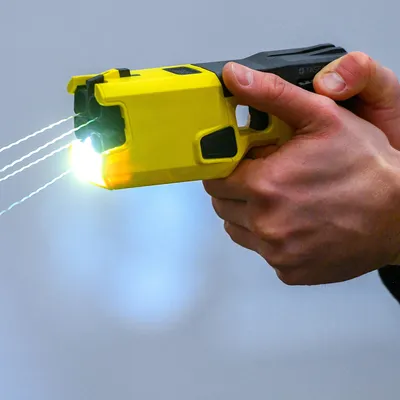
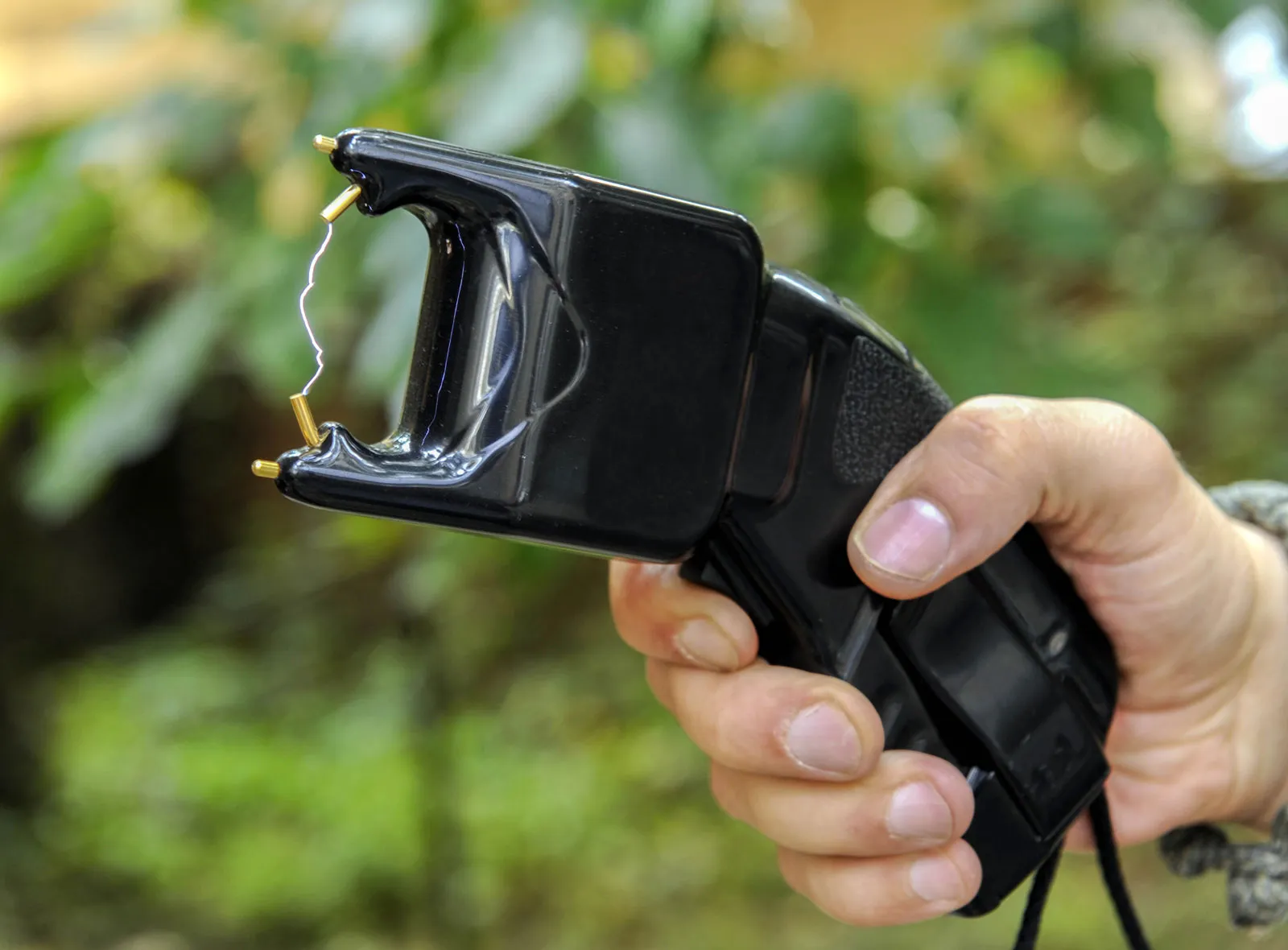
Stun guns deserve separate consideration from the probe-firing devices commonly referred to as Tasers.
For regulatory purposes, St. Maarten could distinguish a direct-contact electrical device, which must be placed against an attacker, from a projectile conducted-energy device that can be deployed from several feet away.
A contact stun device delivers an electrical charge at extremely close range. Its principal value is giving someone confronted physically by an attacker another option besides striking the person or using a firearm.
Its weakness is also obvious: the person defending himself or herself must already be within reach of the attacker.
The National Institute of Justice places stun guns within the broader family of conducted-energy devices.
A St. Maarten framework could potentially allow approved stun devices for adults inside homes and businesses while maintaining tighter restrictions on carrying them in public.
3. Tasers and other probe-firing electrical devices
Taser-type devices represent a higher level of capability and could consequently require a higher level of regulation.
Unlike a contact stun device, a Taser can fire probes attached to wires. An electrical charge transmitted through those probes can produce involuntary muscle contractions and temporarily incapacitate the person struck.
They can provide security personnel with distance from an aggressive individual, but they also carry risks. A person incapacitated by a conducted-energy device can fall and sustain head injuries or fractures.
For that reason, St. Maarten could reserve projectile conducted-energy devices for specially certified security personnel, with mandatory training, recurrent certification, medical protocols and reporting every time a device is discharged.
4. Expandable batons
An expandable baton gives a security officer an impact weapon for close-range defense or control.
Batons have long been incorporated into law enforcement use-of-force systems internationally, but they require training because strikes to certain areas of the body can cause severe injury. The National Institute of Justice lists blunt-impact weapons as one level within less-lethal force options.
Rather than making batons generally available, St. Maarten could consider authorizing them for licensed security officers who complete approved training in defensive tactics, proportional force and safe use.
5. Security fog and forensic marking systems
Some of the most useful alternatives do not require the homeowner or employee to physically confront anyone.
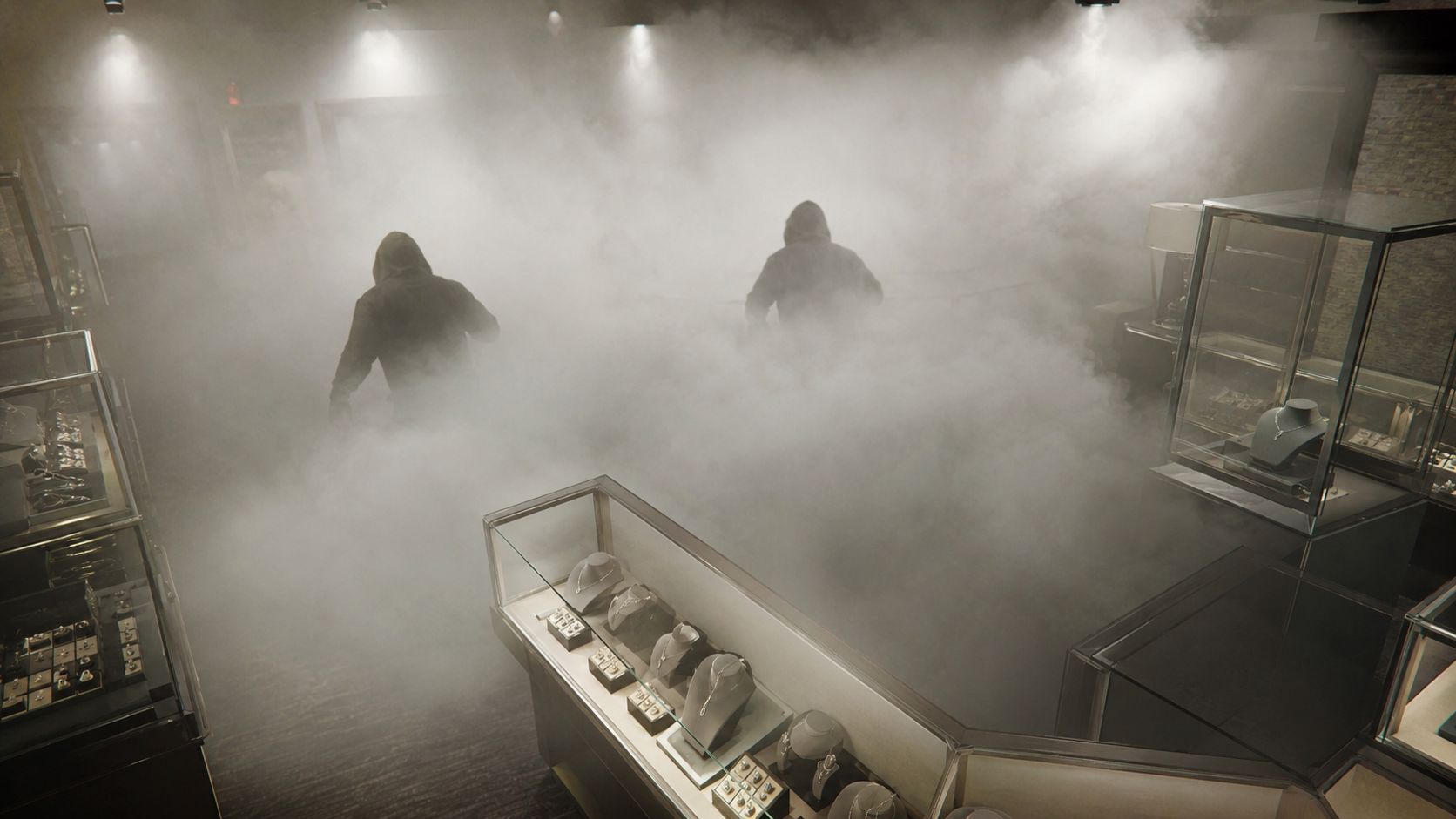
Security fog systems can rapidly fill a protected area with dense fog when an intrusion or robbery occurs, severely restricting visibility and making it difficult for offenders to locate merchandise or move through the building.
Forensic marking systems take a different approach. Some can spray offenders or stolen property with an invisible, uniquely identifiable substance that can later assist investigators in connecting a suspect or recovered property to a crime scene.
Police crime-prevention guidance in the United Kingdom supports forensic marking technologies, including systems that can operate with fog or smoke activation.
Jewelry stores, electronics businesses and other high-value establishments in St. Maarten could be obvious candidates for such technology.
6. Panic alarms, controlled entrances and remote security systems
Technology can also create time and distance without using force.
Silent panic alarms can alert police or security personnel without warning an attacker. Controlled-entry doors can prevent unrestricted access to high-risk businesses. Remote locking systems can isolate sections of a building, while cameras can automatically begin recording and transmit images when an alarm is triggered.
Police commercial-robbery guidance recommends panic alarms, controlled entry, CCTV and other systems as layers of protection for businesses facing robbery risks.
For homes, similar systems can include reinforced safe areas, emergency communication devices and alarms capable of sending immediate notifications to designated responders.
A tiered system for St. Maarten
Rather than treating every defensive device in the same way, St. Maarten could consider a tiered legal system.
At the first level, homeowners and businesses could potentially be permitted approved pepper sprays, approved contact stun devices and non-weapon technologies such as panic alarms, security fog and forensic marking.
A second category could apply to licensed private security officers and include expandable batons, approved irritant sprays and contact electrical devices, subject to training and certification.
A third, more restricted category could cover projectile conducted-energy devices such as Tasers for specially trained security personnel, with more extensive certification and oversight.
Such an approach would not remove firearms from the discussion Labega has initiated. It would broaden the discussion.
The issue before St. Maarten could then become not simply whether more residents or security officers should be allowed access to guns, but whether the country should create a modern legal framework that gives people several regulated defensive options before lethal force becomes the final line of protection.
For residents facing a home invasion, or employees confronted by an armed robber, the minutes before police arrive can be decisive. Determining what lawful tools can reasonably be available during those minutes may be just as important as deciding who should, or should not, be permitted to carry a firearm.