

Between Ambition and Capacity: The questions behind Gumbs vision and St. Maarten’s housing plans
.jpg)
GREAT BAY--When Minister of VROMI Patrice Gumbs appeared in Parliament to discuss housing, he did not arrive with a modest vision. He came with a broad one, framed around one of the biggest social pressures facing St. Maarten: the growing gap between what people need in order to live decently and what the housing market is currently able, or willing, to provide.
The language of the presentation was expansive. Housing, the minister said, is not a commodity. It is a human right. The stated goal was “adequate housing for all St. Maarteners in all stages of their life,” a goal he linked to the United Nations’ Sustainable Development Goal 11 on sustainable cities and communities. In principle, it was hard to argue with the moral premise. On an island where housing pressure touches nearly every sector, from young families and low-income earners to key workers and the elderly, the need for a policy direction has been obvious for years.
But if the presentation laid out a vision, the discussion that followed revealed the deep unease around whether government has the numbers, the institutional capacity, the infrastructure, and the delivery track record to make such a vision real.

A Policy Built on an Old Problem
The minister’s presentation acknowledged something St. Maarten has known for a long time: the housing shortage is not new. Affordable housing has been lacking for years. Social housing supply has not come close to demand. Hurricanes Irma and Maria worsened existing weaknesses by destroying homes and further stressing an already fragile housing sector. Studies after 2017 and in the years that followed kept pointing back to the same problems, long waiting lists, weak institutional frameworks, limited organizational capacity, and an inability to turn years of discussion into actual homes at scale.
The starting point of the minister’s policy presentation was demographic. Census 2022 data, he said, shows a population of roughly 41,000 to 42,000 people, and that number is still growing. At the same time, the population is aging, which means housing needs are also changing in type, not just in volume.
Then came one of the presentation’s most revealing points: household size on St. Maarten has dropped dramatically, from an average of 4.3 persons per household in 1977 to just 2.1 in 2022. Even moderate population growth creates major new housing demand when more people are living in smaller household units. Put simply, more homes are needed even without explosive population growth. The minister argued that these trends make a structured housing policy urgent.

The Data Problem Behind the Housing Problem
Yet one of the first complications in the presentation was that the minister himself admitted the country lacks consistent, up-to-date, reliable housing data. He cited earlier population projections such as the 2012 Building Book, which assumed St. Maarten had about 65,000 people. Official STAT figures for January 2024, he said, show just over 41,000.
That kind of discrepancy changes how demand is measured, how investment should be planned, and how many units government should realistically target. It also raised an immediate question from MPs: if government says the data is weak, then what exactly is the policy’s target based on? That question would become one of the most important challenges to the minister’s presentation.
The Old Laws Behind the New Policy
Gumbs said another key obstacle is the legal framework itself. St. Maarten’s building ordinance and building code date back to 1935. Zoning plans are not fully formalized. There is still no social housing ordinance in place. That means government has lacked the legal tools needed to properly guide development, regulate the market, and ensure housing quality. That legal weakness, according to the minister, is one reason why development has remained difficult to control and largely uncoordinated.
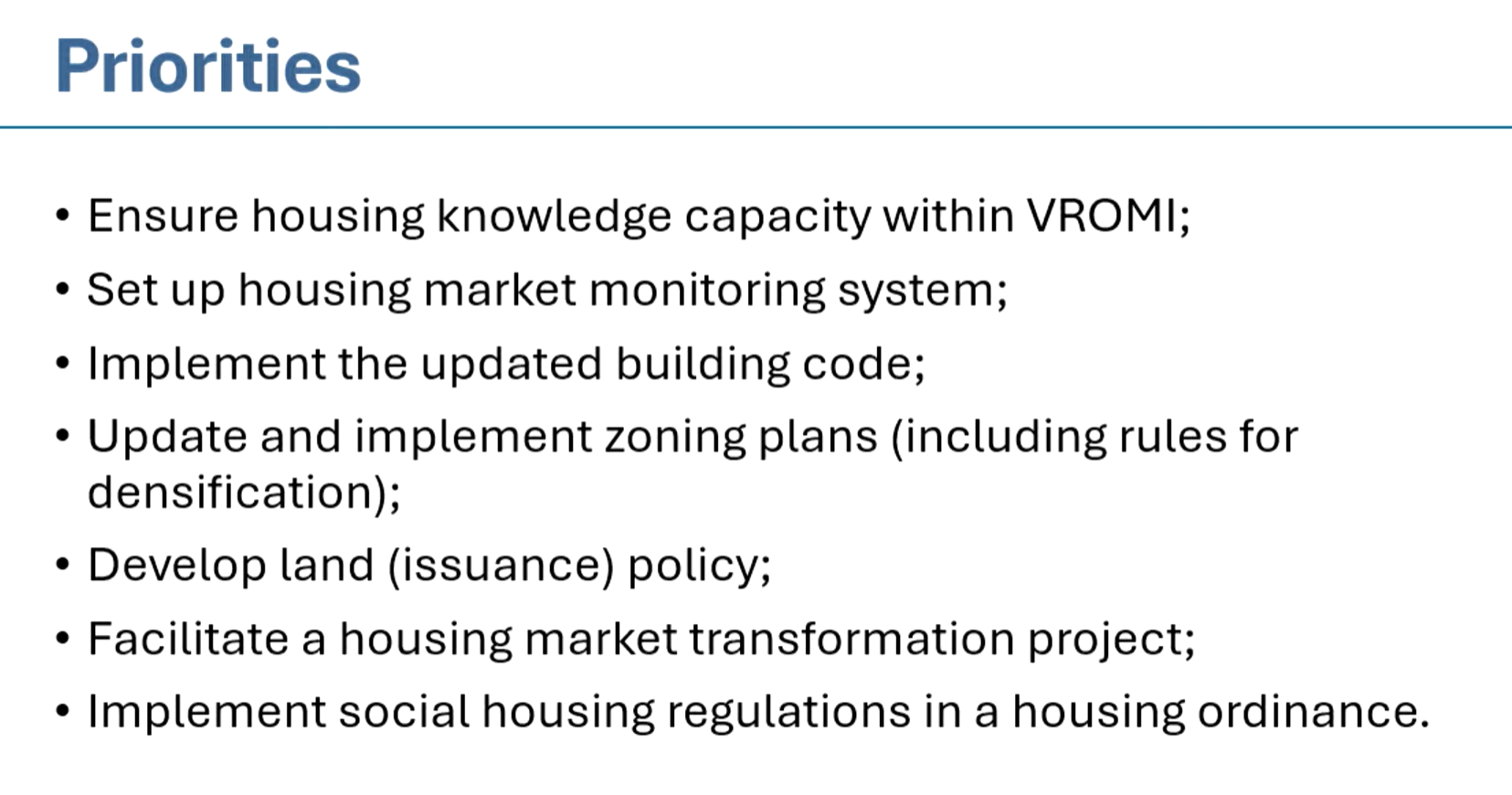
The housing policy, as he described it, is supposed to bring structure to that disorder. It defines low-cost, affordable, and social housing categories and sets out who qualifies for what. It also tries to assign roles, not just to government, but across the wider housing chain: banks, developers, builders, NGOs, institutions, and ministries.
Gumbs noted that while previous housing strategies focused heavily on government and the St. Maarten Housing Development Foundation, the reality is that self-builders and small developers have been the most important producers of housing over the past decades. In that sense, the policy shifts away from the idea that government alone will build its way out of the crisis. Instead, government is supposed to define the rules, facilitate, bring actors together, and help unlock supply.

The Numbers
At the center of the minister’s policy pitch was a set of targets: at least 1,200 homes over the next 10 years, or roughly 120 homes per year. Of those, at least 400 would be social housing units, with at least half for vulnerable groups such as the elderly and persons with disabilities. Another 500 would be affordable homes for middle-income households.
Only about 3 percent of St. Maarten’s housing stock, the minister said, is currently social housing. The St. Maarten Housing Development Foundation maintains 769 rental units, 636 of which are classified as social housing. Yet the data, according to the presentation, shows that at least 25 percent of the population is eligible for this type of housing. In other words, the need and the supply are nowhere near each other.
If 25.5 percent of households are earning 1,650 guilders or less, falling below the European poverty threshold cited by government, then the housing conversation is not just about construction. It is also about what kind of economy St. Maarten has created, and for whom.
Parliament Pushes Back
MP Darryl York was one of the first to dig into that contradiction.
He said plainly that if the country lacks quality, consistent data, then on what exact demand model did government arrive at the figure of 1,200 homes. If the same presentation says that 25 percent of the population is eligible for social housing, why is the annual target not being set much higher? Why aim for a number that appears, from the start, to fall short of the stated need?
His critique went further. If 25 percent of the population needs social housing, York argued, then that says something deeply troubling about the state of the country itself. The crisis is not simply a shortage of units. It is also a crisis of income. In his view, the distinction between affordable housing and social housing matters because they are not the same. If a quarter of the population cannot even access the market at an affordable level, then the problem is larger than housing supply alone.
That led York toward an argument that challenged the core structure of the policy itself. He said he did not believe government could realistically supply enough social housing to close the gap. Instead, he suggested St. Maarten may need to look at broader economic solutions as part of any housing strategy, including salaries, wage tax, and income tax, so that more people can actually afford homes already on the market. In other words, if homes exist, but citizens cannot reach them, is the answer only to build more, or also to raise people’s ability to buy or rent?
York also questioned whether the policy accounts for the cost pressures that are almost certain to affect construction over the next decade. Inflation, higher material costs, global instability, and rising oil and shipping prices all threaten the affordability of any long-term housing buildout. He referred to the conflict involving Iran, rising oil prices, and warnings from shipping companies about steep cost increases. In that context, he argued, government’s numbers may already be too optimistic.
What About Infrastructure?
York also pressed hard on infrastructure. If 1,200 homes are to be delivered, where exactly will they go? Has a comprehensive master plan been finalized? Has government calculated the impact on roads, drainage, sewage, utilities, and traffic capacity, particularly in Belvedere, Dutch Quarter, and access routes into Philipsburg? Has a traffic impact study been done? A hydraulic study? A stormwater drainage study? What happens to runoff when more land is built over?
On St. Maarten, housing cannot be discussed in isolation from flooding, traffic congestion, and aging infrastructure. Every new housing promise carries the shadow of roads that already struggle, drainage networks already under pressure, and neighborhoods that can quickly absorb more burden than they can manage.
York also noted what the public likely assumes, that a significant portion of the new housing will be placed on the newly acquired Belvedere land. But that assumption, he pointed out, raises more questions than answers. How much of Belvedere is already developed? How many homes are there now? How much land is actually available? And how does the planned cemetery space on the same property affect the overall housing vision?
Those questions linked one major national issue to another. Belvedere is not just housing land. It is also being discussed as future cemetery land. Once you start carving out land for burials, roads, infrastructure, utilities, and open space, the public is right to ask how much room is truly left for the housing scale being promised.
Old Housing, Not Just New Housing
MP York asked about the emergency homes built after Hurricane Luis in places such as Union Farm, Cole Bay, South Reward, and Sucker Garden. What is their legal and management status today? Were they ever meant to remain temporary, or have they effectively become permanent over the last 30 years? Is there a plan to transfer ownership to the people living in them?
MP Christopher Wever picked up on that same issue. He said that while he was in office, there were already discussions with the Housing Development Foundation about turning over homes in areas like Pointe Blanche and South Reward to current occupants. That, he suggested, would not only reduce the Foundation’s maintenance burden but also give families a route to ownership and improvement.
His comments raised a practical truth often overlooked in large housing plans: one of the quickest ways to strengthen housing security may not always be through new construction, but through converting long-occupied units into owned homes.
Wever also cut to another bottleneck, permitting. If the country is already seeing permit applications and building extensions delayed for years, then how is government going to process enough approvals to support 120 homes a year, while also handling regular private applications? It is one thing to set a target. It is another to ask whether the permit department can process the pipeline needed to achieve it.
That same practical concern came up again when MPs asked whether public-private partnerships are really viable if permit approvals remain so slow. Could government prioritize permits for developers willing to partner on social or affordable housing? And if so, what mechanism would guarantee that?
Gumbs also mentioned the revival of the mortgage guarantee fund. MP Ardwell Irion said the resurrection of the fund had begun while he was in office and asked whether any banks have actually committed to it. More importantly, he wanted to know what government will use to back it. If government wants to stand behind mortgages, will it put cash on the table? And if so, where is that reflected in the budget? For him, if the mortgage guarantee fund is not clearly backed in the 2026 budget, then it remains more concept than concrete instrument.