

Curaçao’s Blue Wave and Haiti’s Les Grenadiers will carry two powerful Caribbean stories into the World Cup

For the Caribbean, the 2026 FIFA World Cup will not be watched from a distance. It will be felt in blue, red, yellow, rhythm, memory, hope and pride.
Curaçao and Haiti arrive at the tournament through different roads, shaped by different realities, but their stories now meet on football’s largest stage. One is the smallest nation ever to qualify for a World Cup. The other is returning after 52 years, carrying the emotions of a people who have endured crisis, displacement and uncertainty, yet never surrendered their love for the game.
Together, they represent something larger than sport. They represent the ability of Caribbean nations to rise above size, hardship and expectation.
For Curaçao, the achievement has already become a Kingdom-wide moment. Across the Dutch Caribbean, from Aruba and Bonaire to Saba, St. Eustatius and St. Maarten, there is a sense that Curaçao’s qualification belongs to more than one island. It is Curaçao’s team, Curaçao’s work and Curaçao’s history, but the emotion has spread through the Dutch Caribbean like a shared victory. In small island communities where football pride often travels through family, diaspora, schoolyards, amateur clubs and weekend rivalries, Curaçao has given the region a World Cup team to rally behind.
The island made history by becoming the smallest nation ever to reach the tournament, both by population and land area. For a country of roughly 156,000 people, the scale of the achievement is difficult to overstate. Curaçao did not stumble into the World Cup. The team went unbeaten through 10 qualifying matches, built momentum through key results, and sealed its place after a goalless draw against Jamaica.
That result carried the force of a national release. Curaçao had spent years building toward this opportunity. Since becoming a FIFA member in 2011, the island has drawn strength from a deep football connection with the Netherlands, especially through Dutch-raised players with Curaçaoan roots. That link has helped Curaçao build a squad with experience, discipline and technical ability, while still carrying the emotional identity of the island.
The Blue Wave, as Curaçao’s team is known, now enters Group E against Germany, Ecuador and Côte d’Ivoire. The challenge is enormous. Germany brings pedigree, Ecuador brings pace and structure, and Côte d’Ivoire brings power and tournament experience. But Curaçao’s presence in that group is already a statement. The team is not there as a novelty. It is there because it earned its place.
article continues below...
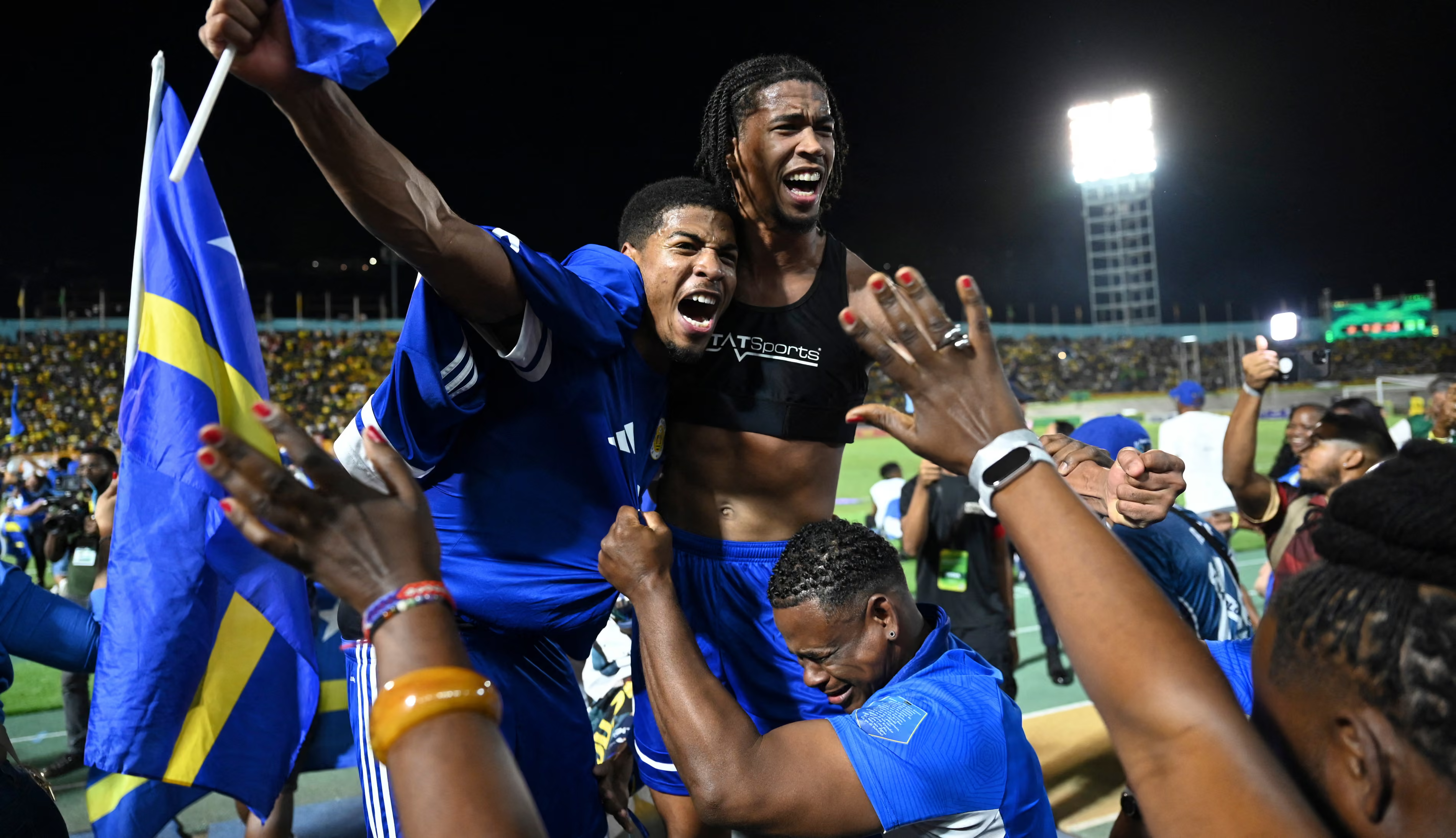
The Guardian’s preview of Curaçao points to a team that wants to continue playing football with possession and confidence, but also understands that the World Cup will demand adjustment. Against stronger opponents, Curaçao may not always have the ball. It may have to defend for longer stretches, absorb pressure and choose its moments carefully. Still, the identity remains important: play with courage, build from the back, and trust the quality that carried the team this far.
At the center of the story is Dick Advocaat, the veteran Dutch coach whose career has taken him across major clubs and national teams. At 78, Advocaat is set to become the oldest coach to appear at a World Cup. His return to Curaçao’s bench added another layer to an already unusual and emotional journey. In a tournament often dominated by football giants, Curaçao will arrive with a coach whose experience is matched by the rarity of the story he now leads.
On the field, Leandro Bacuna stands as one of the faces of the team. A longtime Curaçao international, former Premier League player and captain, Bacuna represents both football quality and deep community connection. Alongside his brother Juninho Bacuna, he belongs to one of Curaçao’s best-known football families. Their story links past and present, from the former Netherlands Antilles to the modern Curaçao national team.
There are also emerging names with the potential to capture wider attention. Livano Comenencia, developed through PSV and Juventus’ Next Gen setup before moving to FC Zürich, gives Curaçao a young midfield presence with technical quality and energy. Juriën Gaari, described in the Guardian preview as a steady and respected defensive figure, brings experience and reliability to a team that will need composure under pressure.
But beyond the tactics and player profiles, Curaçao’s qualification has created something that statistics cannot fully capture. It has ignited the Dutch Caribbean. For many in St. Maarten and across the wider Dutch Caribbean, Curaçao’s World Cup place feels familiar and personal. The islands know what it means to be small, to be overlooked, to be measured by population rather than potential. Curaçao has disturbed that logic.
That is why so many Dutch Caribbean fans are expected to follow every match, whether in stadiums, homes, bars, community gatherings or through late-night broadcasts. It is not simply about rooting for a neighboring island. It is about seeing a familiar Caribbean identity placed on the world stage and refusing to look small.
Haiti’s road carries a different emotional weight.
The Grenadiers return to the World Cup for the first time since 1974. Their qualification comes at a time when Haiti continues to face political instability, insecurity and economic hardship. The national team had to play every qualifying match away from home, cut off from the full force of a home crowd and the normal comforts of national competition. Yet the team endured, adapted and advanced.
That alone gives Haiti’s qualification a special place in this tournament. In many ways, Haiti’s story is one of football in exile. The team played without the ordinary geography of home advantage, but not without home. The country traveled with them in spirit, through the diaspora, through memory, through the flag, through fans who have waited more than five decades to see Haiti return to this level.
The Guardian’s Haiti preview describes a team shaped by discipline, intensity and transition football under French coach Sébastien Migné. Haiti finished behind Curaçao in Concacaf Group C before winning its third-round qualifying section, including important victories over Costa Rica and Nicaragua. That path showed that the Grenadiers were not relying only on emotion. They had a clear tactical structure and the quality to execute it.
Migné’s role is one of the more striking elements of Haiti’s story. He has helped build a team during one of the most difficult periods in the country’s recent history. According to the Guardian preview, he has not set foot in Haiti because of the security situation. That fact makes the team’s rise even more unusual. It also underscores the dislocation that surrounds Haitian football at this moment. The team is carrying a country that many of its players and staff cannot safely gather in, yet the emotional bond remains intact.
article continues below...
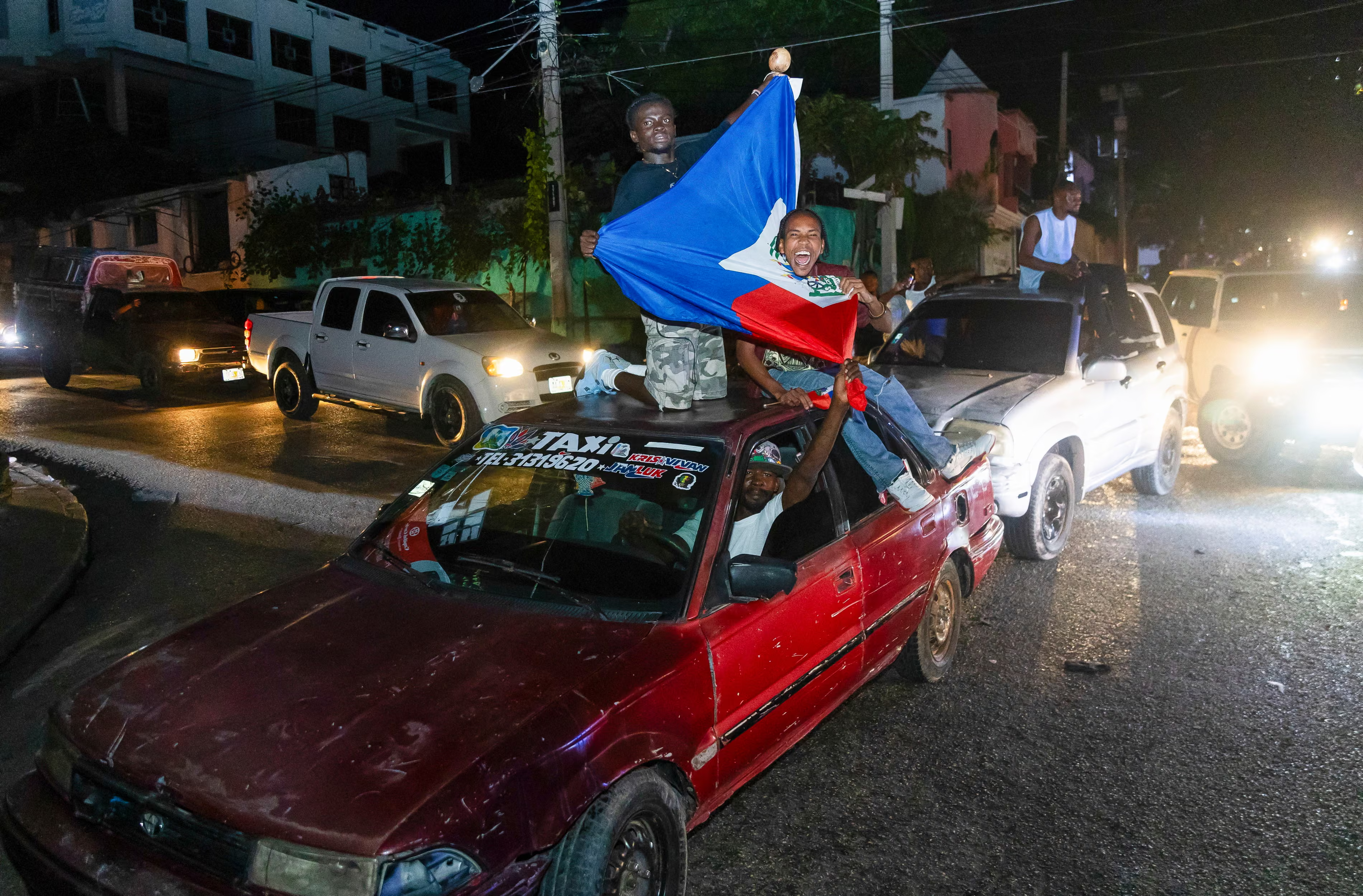
Haiti enters Group C against Scotland, Brazil and Morocco. Like Curaçao, Haiti faces a difficult draw. Brazil needs no explanation. Morocco arrives with global respect after its recent international rise. Scotland brings physicality, organization and tournament ambition. But Haiti’s path has already shown that it is capable of troubling stronger opponents, especially when it can defend with discipline and move quickly into attack.
The leaders of the team are central to that possibility. Duckens Nazon remains one of Haiti’s most recognizable attacking figures. Frantzdy Pierrot, Ricardo Adé and veteran goalkeeper Johny Placide add experience and balance. Jean-Ricner Bellegarde gives the midfield energy, while Wilson Isidor offers pace and attacking danger. Ruben Providence, still largely unknown to many casual World Cup followers, could become one of the tournament’s Caribbean breakout names if Haiti finds space in transition.
There is also Danley Jean Jacques, the kind of player whose work is often appreciated most by teammates and coaches. Haiti will need that type of midfield engine in a group where control will not come easily. Against Brazil and Morocco especially, Haiti may have to spend long periods without the ball, protect central areas and break forward with speed and accuracy.
For Haitian fans, the tournament is more than a sporting return. It is a gathering point. From Port-au-Prince to Miami, Boston, New York, Montreal and beyond, Haiti’s diaspora will carry the Grenadiers with full voice. The Guardian preview notes that Haitian supporters are expected to bring drums, chants and national color into the stadiums and watch parties. That support matters because Haiti’s qualification belongs as much to those who have waited and suffered as to those who played.
Still, the joy is complicated. Travel restrictions, visa issues and high ticket prices may prevent many Haitian supporters from reaching the matches in the United States. That reality adds another hard edge to the story. A team that carried its country through exile may still have fans blocked from witnessing the moment in person. Yet if there is one thing Haiti’s football journey has already shown, it is that distance does not erase belonging.
Curaçao and Haiti now enter the World Cup as two Caribbean teams with two powerful narratives.
Curaçao represents possibility beyond size. Haiti represents resilience beyond hardship. Curaçao carries the Dutch Caribbean’s shared pride into the tournament. Haiti carries the weight and hope of a nation and its diaspora. One story is about making history for the first time. The other is about returning to history after 52 years.
Neither team will be judged only by whether it advances from the group stage. Of course, results matter. Football is not sentimental once the whistle blows. Germany, Ecuador, Côte d’Ivoire, Scotland, Brazil and Morocco will not offer easy passages. But for Curaçao and Haiti, reaching this stage already changes the conversation around Caribbean football.
It tells young players on small islands that the World Cup is not only for countries with large populations, billion-dollar leagues and endless facilities. It tells the Caribbean that football dreams can be organized, disciplined and achieved. It tells the diaspora that roots still matter. It tells the world that the region is not just a place of talent export, but also national identity, tactical growth and collective ambition.
When Curaçao walks out against Germany, the Dutch Caribbean will be watching. When Haiti walks out against Scotland, Brazil and Morocco, Haitians everywhere will feel the weight of 52 years. And when both teams line up under the lights of the 2026 World Cup, the Caribbean will have two reasons to stand taller.
Source credit: This feature was written using information from The Guardian’s 2026 World Cup Experts’ Network preview series, specifically the Curaçao team guide by Arthur Renard, published June 1, 2026, and the Haiti team guide by Pierre Richard Midy, published May 30, 2026.