

Finance Minister moves to abolish land and inheritance taxes, to end "legislative ghosts", "colonial relic"
.jpg)
GREAT BAY--Minister of Finance Marinka Gumbs presented draft legislation in the Central Committee meeting of Parliament on Friday aimed at formally retracting two long-standing but unenforced tax ordinances, the Land Tax Ordinance and the Inheritance Tax, framing the move as both a practical modernization step and a defining policy statement about land, identity, and intergenerational security in St. Maarten.
Continues below...
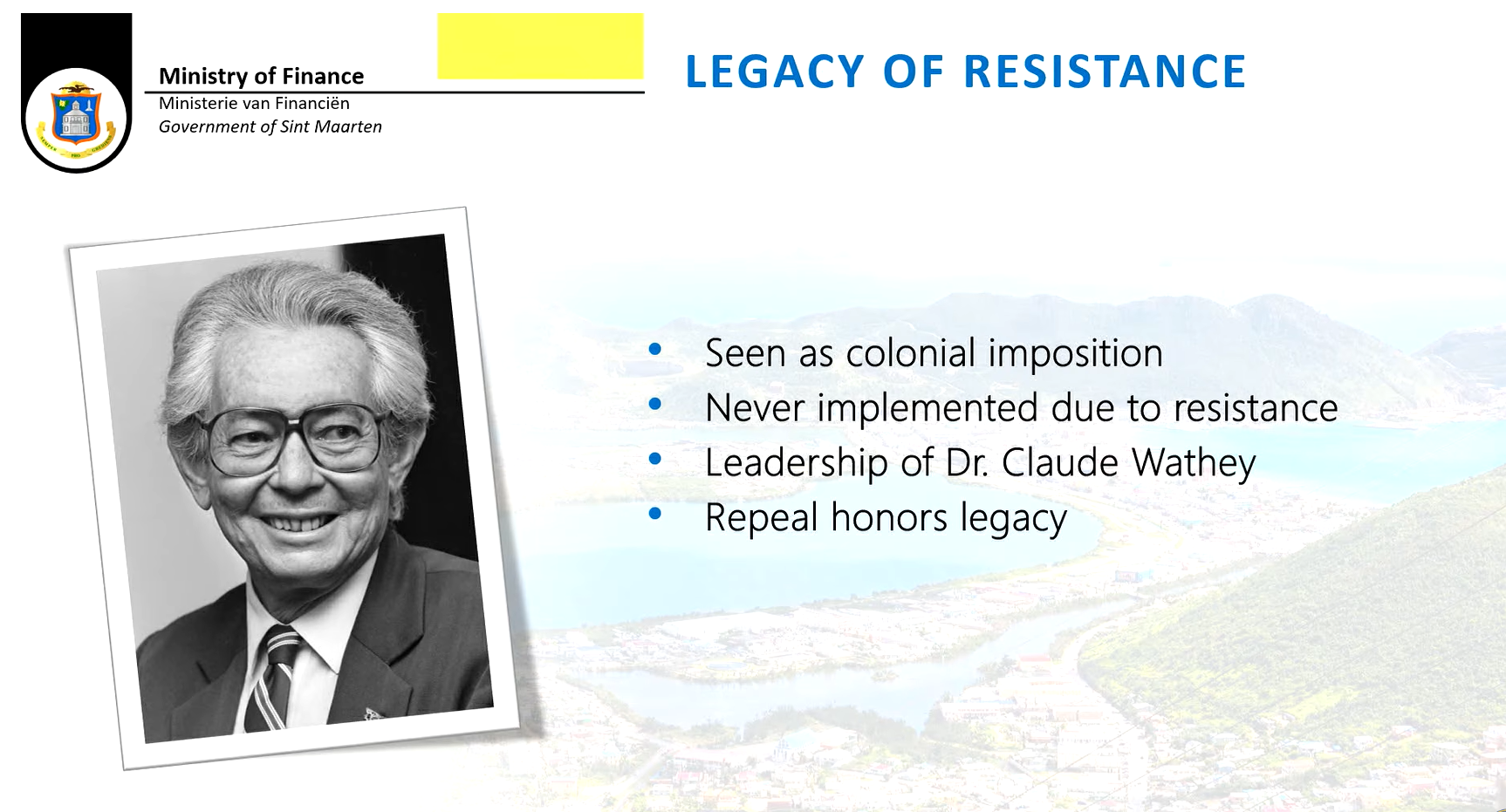
Addressing Parliament, the Minister described the moment as significant and she positioned the proposal as a major step in aligning written law with lived reality in St. Maarten, and tied the timing to ongoing reflections on history and identity, referencing the centennial period linked to Black history observance and the purpose of protecting historical memory.
The Minister told Parliament that the draft law would formally abolish both the land tax and the inheritance tax, emphasizing that both laws have been on the books for more than half a century but were never enforced in St. Maarten. She explained that the current land tax rate, as written, is 0.3 percent of the property’s value, charged to the owner, and that this would technically affect succession land holdings across the island.
At the same time, she stated clearly that abolishing these taxes would not affect other taxes connected to real estate transactions, including transfer tax, described as a one-time 4 percent tax on the transfer of real estate upon purchase, and other applicable fees associated with land tenure arrangements such as long lease.
Colonial relic
The Minister’s presentation focused first on land tax, characterizing it as a colonial-era instrument resisted for decades by St. Maarten’s political leadership. She argued that land in St. Maarten is not simply a financial asset, but a core pillar of identity and belonging, and that succession land, in particular, reflects the historic determination of families to keep land within traditional lines even when cash resources are limited.
In this context, the Minister highlighted the legacy of Dr. Claude Wathey for resisting implementation of the land tax and for recognizing the risk that taxing land ownership could push “land rich but cash poor” families into forced sales over time. She told Parliament that repealing the ordinance would finalize that long-standing resistance and remove what she described as an ever-present risk embedded in the statute books.
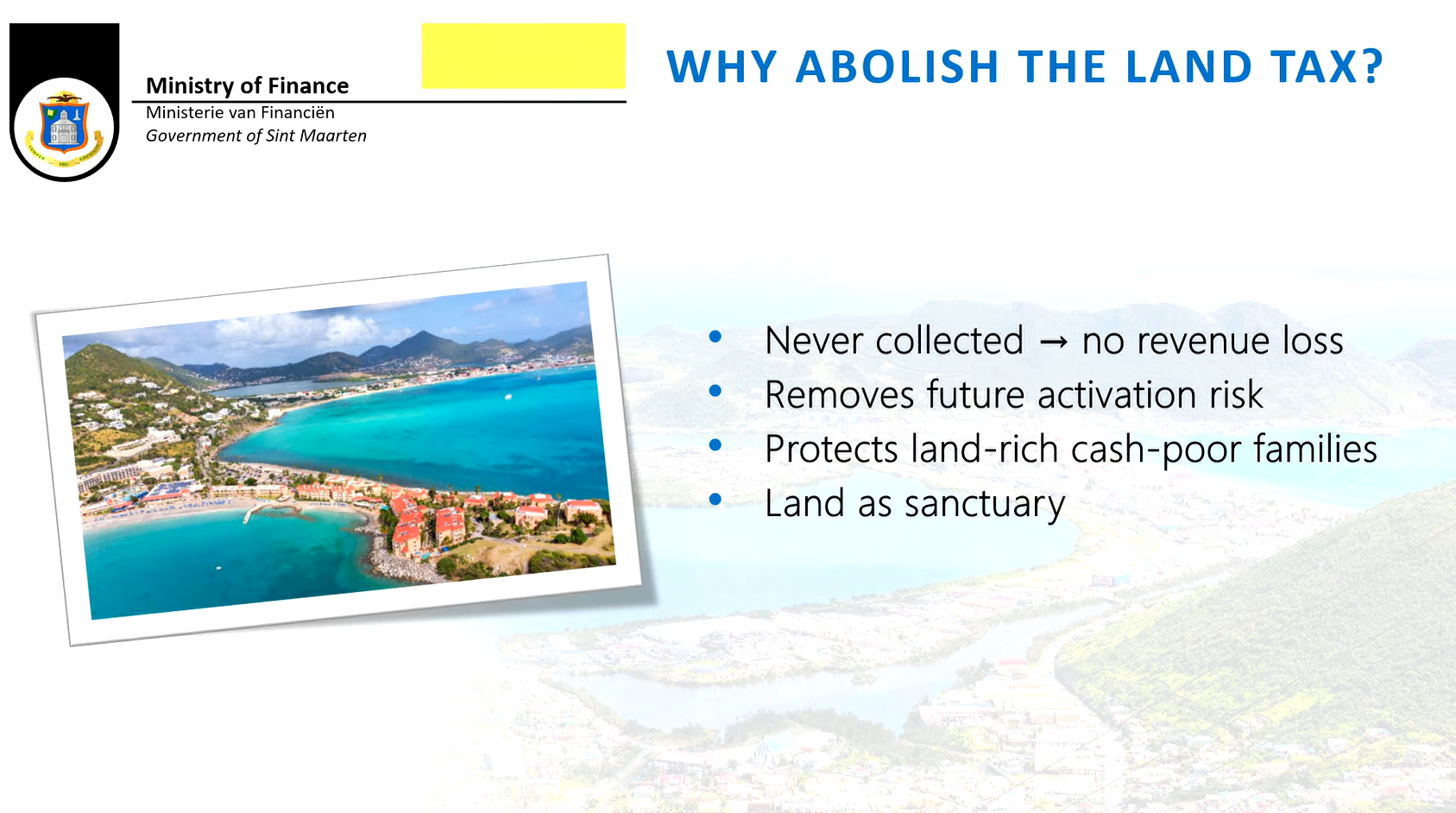
A central practical argument repeated throughout her presentation was that government would not be giving up revenue by repealing a tax that has never been collected. In her words, the repeal would create legal certainty and prevent any future administration from activating the land tax without a broad policy debate, thereby removing ambiguity and anxiety for landowners.
The Minister pointed to Bonaire as a cautionary example in the regional Kingdom context, stating that developments there, including tensions tied to land and local anxieties about being pushed out, should serve as a warning of how land-related tax policy can escalate pressure on residents. She argued that this made St. Maarten’s decision to formally repeal the land tax even more urgent.
Inheritance tax described as unfair and disruptive
Turning to inheritance tax, the Minister argued that the tax falls on families during moments of loss and vulnerability, describing it as fundamentally unfair in a society where wealth is often tied up in land and family enterprise rather than liquid cash.
She emphasized that inheritance taxes can create legal entanglements, freeze development, and divide families, particularly when succession land is involved. She also argued that the assets being taxed at death were typically built with income already subjected to other taxes during a person’s lifetime, and that taxing the same value again at death functions as an additional penalty rather than fair fiscal policy.
Continues below...
A stated policy shift
The Minister framed the draft law as part of a broader strategic shift in tax philosophy and national competitiveness. She told Parliament that St. Maarten should move away from taxing what people own and toward incentivizing what people build, renovate, and develop. She described the objective as making St. Maarten highly competitive, investor-friendly, and family-oriented, while protecting local ownership and preserving intergenerational wealth.
She also described the proposal as an early step in a wider tax reform program being pursued by her Ministry under the theme “Stabilize, Repair, Reform,” describing a phased approach to system renewal that strengthens administration and promotes fairness.
The Minister said repeal would allow the Tax Office to focus its capacity on modernization, including improvements to IT systems and compliance, rather than devoting resources to inheritance-related cases involving individual families. Her position was that responsible fiscal management should prioritize enforceable, efficient revenue sources, rather than keeping unused instruments in law as theoretical options.
MPs respond, broad support
MPs largely welcomed the proposal, while raising questions about long-term fiscal strategy, land protection mechanisms, and complementary reforms.
MP Francisco Lacroes said the proposal was a clear example of legislation that would mainly benefit locals, and suggested the country consider a tax on property sales to foreigners, noting that other jurisdictions apply stamp duties or comparable charges on foreign buyers. He asked whether St. Maarten has a similar mechanism and whether it could be used as a revenue generator while protecting local land retention.
MP Chris Wever commended the Minister and her team for what he described as a clear and thorough presentation and expressed support for abolishing both ordinances so they can never be implemented.
MP Labega echoed support but posed formal questions on the need for repeal if the taxes were never enforced, potential impacts on the real estate market, arguments that inheritance tax promotes redistribution, and how abolition aligns with responsible fiscal management.
Several questions pressed for a clearer “whole-of-reform” roadmap. MPs raised questions about whether long-term fiscal modeling has been done, what the broader tax reform sequence will be, and how government intends to secure resilience during economic downturns, tourism fluctuations, or unexpected revenue shortfalls.
MP Darryl York raised concerns about pensioners and workers with multiple streams of income being pushed into higher tax brackets once incomes are aggregated at filing time, arguing that the system can discourage modest success and contribute to a weaker middle class. He asked for public clarification and for relief measures to reduce the burden on pensioners and those supplementing income after retirement. A follow-up emphasized that the concern applies to multiple small income streams, not only one specific profession.
MP Sjamira Roseburg referenced documentation received by Parliament noting the legacy of unclear land ownership, transfer, and registration dating back to slavery-era and post-abolition realities, with succession land structures and ongoing legal procedures. She asked whether the historical sensitivity and potential long-term implications for family property rights and legal processes were considered.
MP Jansen-Webster highlighted how the repeal could pair with other reforms aimed at enabling families to reach agreement and divide or formalize land interests more efficiently, cautioning that policy should ultimately empower families rather than accelerate sell-offs.
In response to the questions, the Minister began by stating that formal repeal is needed because an administration could activate these taxes without broad policy debate. Repeal removes ambiguity and provides long-term predictability for families and investments.
She stated that removing the risk of annual land taxation and inheritance burdens strengthens long-term confidence in property ownership, encourages development and renovation, and supports generational retention of land, while also improving the jurisdiction’s attractiveness to investors and returning diaspora.
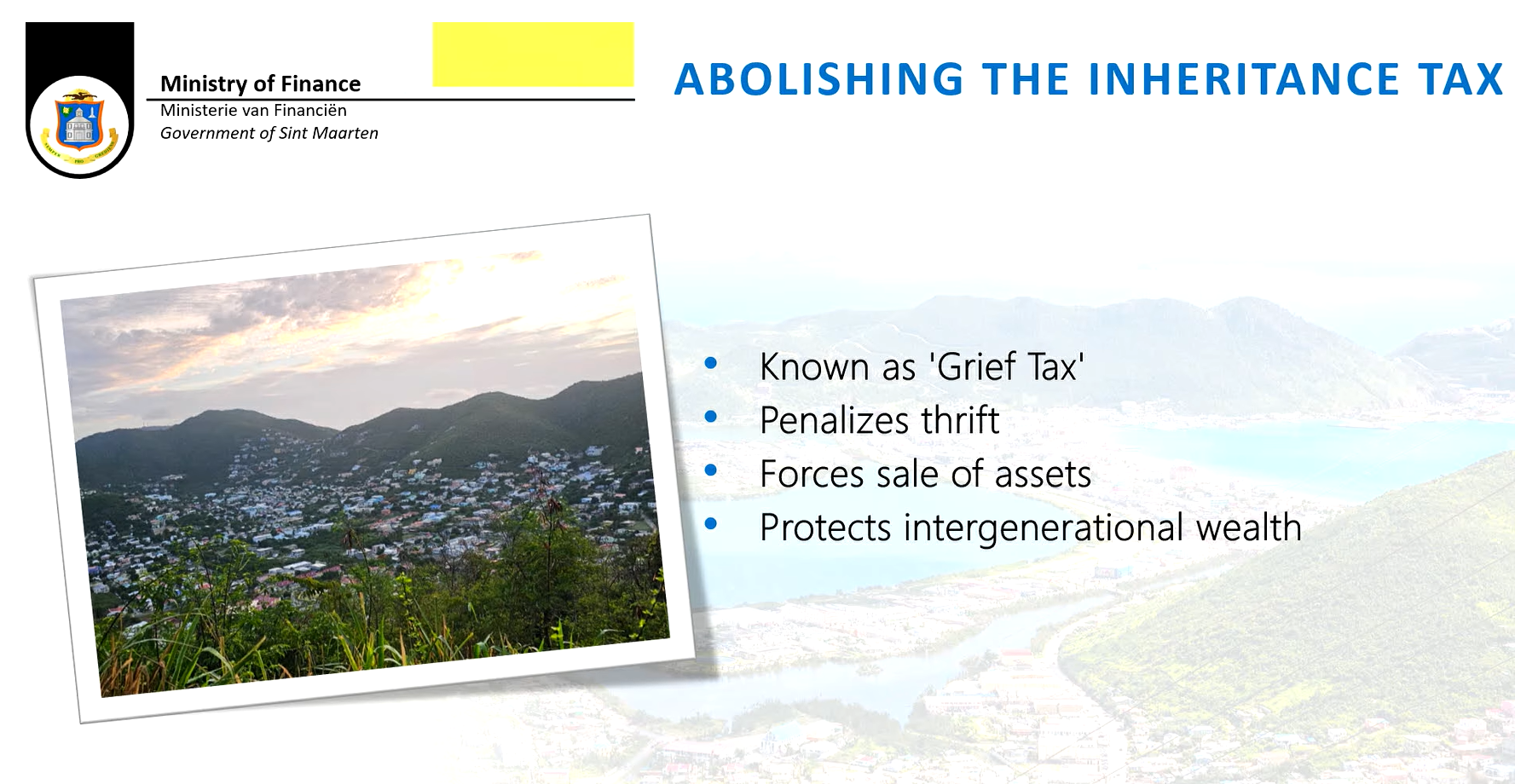
She argued that inheritance tax effectively taxes assets that were already taxed during the deceased’s lifetime and that, in St. Maarten’s context where wealth is often land-based, abolition is fairer and reduces pressure that can trigger forced sales.
Continues below..
She stated that responsible fiscal management is not about retaining unused instruments, but about focusing on efficient, enforceable revenue sources, strengthening compliance, modernizing systems, and encouraging growth.
The Minister added that the reform safeguards families that are land rich but cash poor, preventing annual tax or inheritance levies from creating financial pressure that could lead to forced sales, and that predictability strengthens competitiveness and long-term certainty.
The Minister described the repeal as removing outdated and symbolic burdens, with next steps focused on modernizing compliance in existing streams, refining business taxes, and proceeding through structured phases.
Minister Gumbs stressed that tax policy is not only economic, it is social, and that land represents identity, legacy, and stability, making it important that the legal framework reflects lived cultural reality and strengthens public trust.
The Minister thanked MPs who proposed exploring taxes tied to property sales to foreigners and said those considerations can be examined within broader tax reforms. She maintained that the legislation before Parliament concerned abolishing land and inheritance tax, while noting that other revenue avenues can be explored and communicated as part of broader reform.
In response to concerns about long-term impacts, she stated that because both taxes were never executed, they have not affected households, businesses, land use, or government revenues, and their repeal is therefore not expected to have measurable socioeconomic impact.
Addressing questions on pensions and multiple income streams, the Minister explained that pension payout is taxed when paid out, and that multiple small income sources may individually fall below thresholds but can place a person into a taxable bracket once aggregated at annual filing. She said this reflects how the law treats total income, not necessarily incorrect taxation, while acknowledging the burden this can create. She stated she recently met with APS to discuss practical solutions and said more information would be shared publicly. She also stated that her Ministry is reviewing the treatment of AOV and taking steps toward addressing its treatment, clarifying her intention to move toward AOV being treated as non-taxable income.
Responding to concerns about historic land and inheritance sensitivities raised by MPs, the Minister said the repeal of these two taxes would not impact the issues described, while acknowledging their importance in the broader land and ownership landscape.
She added that her Ministry is working to extract needed data from systems with support from a data analyst. She also said she would request that Kadaster indicate whether it has, or can compile, information on the breakdown between domain land and privately held land.
She went on to acknowledge calls for a clearer timeline and a Cabinet-level vision statement outlining what comes first and what comes next under the current administration. She indicated that tax reform has multiple components across different laws and cannot be delivered in a single sitting, but said priorities under the current Cabinet will be clarified as work progresses.
MP Darryl York reiterated his concern that the total abolition of land tax may be moving forward without sufficient exploration of alternatives, particularly mechanisms ensuring that external investors contribute meaningfully, and he repeatedly requested clearer policy direction and findings from any exploration of options. He argued that Parliament needs a departure point and vision for reform, even if legislation is phased.
The Minister replied that while differing opinions may exist, she does not agree with delaying action on measures that have no practical benefit, emphasizing that the two ordinances at issue were not being used and provided no revenue. She reiterated that other revenue-generating avenues can be explored and communicated, but her purpose in the meeting was to request Parliament’s support to abolish the land tax and inheritance tax.
The Chair indicated that the Central Committee discussion would be captured in a report for further handling of the draft ordinance, forming the basis for the public meeting phase of the legislative process.