

“Hey Travelers!”: How Naomie Mazzola became the face of PJIA by blending creativity, psychology, and people skills
.jpg)
At Princess Juliana International Airport, one of the most recognizable voices in public-facing communication comes from a familiar greeting, delivered with energy, ease, and confidence: “Hey Travelers.”
That greeting, now closely associated with PJIA’s social media presence, has helped make Naomie Mazzola one of the most visible examples of modern communication in St. Maarten’s corporate space. But the ease with which she appears on camera, and the clarity with which she delivers information, are built on years of discipline, training, creativity, and lived experience. Her path into the field was not a straight line, and that, perhaps, is part of what makes her story so relevant, especially for young people trying to imagine what a career in communication can look like.
The place and family that shaped
Mazzola describes herself first through the place and family that shaped her. Born and raised in St. Maarten, she comes from a mixed background, with a Dominican mother and a father of Italian heritage who has lived in St. Maarten since he was eight years old. As the first child and granddaughter in her family, she grew up in an environment where education mattered deeply, where strong performance in school was expected, and where good grades were not optional but part of the standard set around her. She says school came easily to her, and she enjoyed it, but she is also clear that her success was shaped by more than natural ability. The schools she attended, and the encouragement she received from teachers, played a major role.
Her educational journey began at the St. Maarten Montessori School, an experience she says helped make her independent while also giving her room to express herself freely. Later she attended CIA, where she continued to excel academically while leaning even more into creativity. She was the kind of student who not only did well in class, but also threw herself into the wider life of the school. She joined clubs, served as vice president of the student council, gave tours to prospective students and parents, ran the sound booth for school concerts, and volunteered constantly. By her own account, she was “almost never in class,” but her grades never suffered. She graduated as valedictorian in 2014. Her teachers, she says, still encourage her when they see her work on social media today.
Continues below...
That mix of academics and creativity was reinforced at home. Mazzola grew up in a family business environment. Her father owned what she describes as the first sign and promotional items company on the island, and her mother, a strong salesperson, eventually went into the same line of work. She and her siblings were not raised to sit quietly in an office waiting for the workday to end. They were expected to learn the trade. By age six, she had already been given a laptop loaded with programs like Photoshop. There was no Wi-Fi at home, so she learned the software by working through it herself. She learned to do the same kinds of tasks her parents were doing, and she and her siblings were often trusted to speak with new clients and handle sales on their own. In school, she used those same design instincts in her projects and presentations, which she says were always “extra.” Those early years, spent inside a real business, taught her both practical skills and work values she still relies on today.
Even so, choosing a field of study was not easy. When it came time to decide on a university program, Mazzola says she felt lost. Her father wanted her to study Marketing. She herself was drawn to dramatic arts and writing. In the end, she chose Psychology, a path she describes as both meaningful and unconventional for the island at the time. She wanted to understand people better and help them, and she was also aware that psychology remained taboo in many circles in St. Maarten. She saw in it something she could one day bring home and help advance. She eventually earned a bachelor’s degree in Applied Psychology from a university in Canada, and while studying there she focused not just on the discipline itself, but on how psychological methods could be adapted to Caribbean culture. She developed a full thesis on how to better support the mental health of Caribbean people while respecting local beliefs and traditions.
She spent eight years away before returning home, and when she tells that part of the story, she uses a phrase that reveals how deeply her upbringing stayed with her: if your father is a fisherman, she says, then you are by default a fisherman, even if you train to be a doctor. In other words, the skills and instincts you are raised in do not disappear. After returning to St. Maarten, she first worked for another company managing its social media, where she says she found success. That led to a recommendation, and in April 2024 she took over PJIA’s social media as its social media manager. She says she has poured a lot of herself into the role, and believes the results reflect a work ethic she was taught early, when you do something, you do it well.

Her role at the Princess - Hey Travelers!
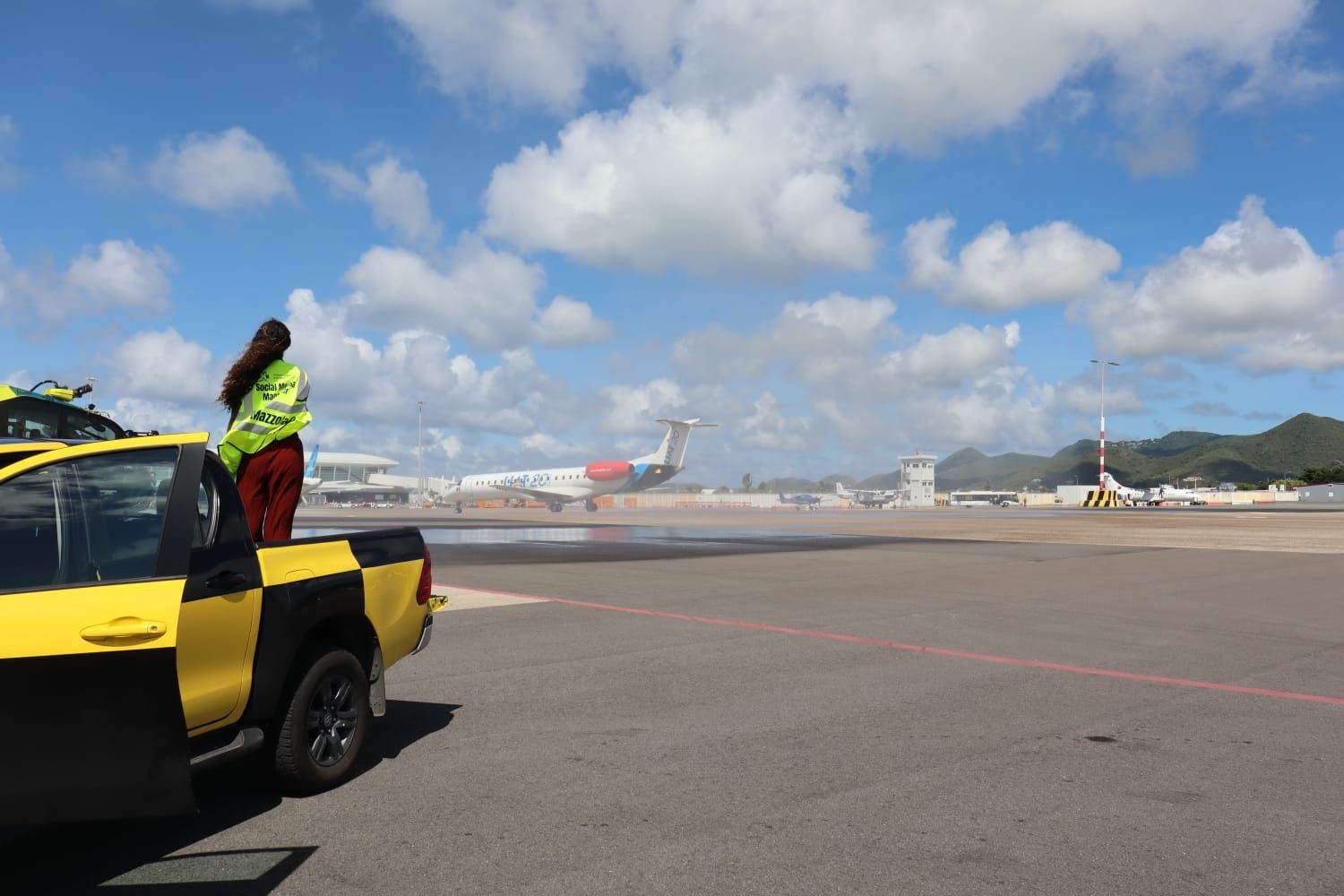
Her role at PJIA is much broader than simply posting online. Mazzola handles end-to-end content creation. That includes producing and editing video, designing graphics for static posts, and managing community engagement by responding to messages and questions across the airport’s social media platforms. She also analyzes performance metrics, develops strategy, and works with different departments to understand what communication support they need, whether that means operational messaging or even HR vacancy announcements. She has also become the face of selected campaigns, most notably the recurring “Hey Travelers” series that now forms part of PJIA’s public identity.
That now-familiar “Hey Travelers” style did not emerge as a carefully planned corporate branding exercise. It came out of observation, study, and improvisation. Mazzola says she spends a lot of time studying the airport’s pages, reviewing comments, reading suggestions, and watching how audiences respond. She pays attention not just to what other airports are doing, but to the audience PJIA is trying to reach, the messages it needs to send, and the community that is actually engaging with the page. About a year after taking over, she noticed that videos featuring people performed best. The problem was that finding people to appear in videos was not always easy, especially because many of her ideas come in the moment and need to be filmed that same day to keep the content organic. One day, she simply decided to use herself. She improvised the first “Hey Travelers” video, made up the tagline on the spot, and it stayed.
Over time, that spontaneity became a communication tool. Mazzola uses “Hey Travelers” for important messages and moments when something special is happening at PJIA. She believes having a consistent, recognizable person on camera builds familiarity, and with familiarity comes trust. She describes herself as naturally quirky and energetic, saying that the person viewers see in those videos is the same person walking the terminal greeting passengers and staff. The authenticity matters to her. Nothing is scripted, and most of the time she improvises. She even jokes that she once won the drama class award in high school, a small detail that now feels like an early hint of where her strengths would lead. Her view is simple: people connect with people, and a relatable, recurring figure creates a sense of security as well as engagement.
The approach isn't one-size-fits-all
That does not mean she approaches every message the same way. Airports, after all, do not communicate only fun or lighthearted content. They deal with delays, disruptions, safety notices, and sensitive incidents. Mazzola says the key is remembering that PJIA is a busy airport serving large numbers of passengers every day, many of whom are anxious about travel in the first place. Her approach, even in serious situations, is to humanize the message. She leans heavily on empathy, something she says her Applied Psychology background helps her do. She tries to put herself in the audience’s position and asks how to deliver the necessary information in a way that is still relatable. For serious situations, she works alongside PJIA Communications Officer Cassie Schoutens, and together they determine the best way to communicate with the public and traveling passengers.
Those viral vids
When content goes viral, Mazzola does not reduce it to one factor. In her view, virality usually comes from a combination of message, personality, clarity, and humanity. Many of PJIA’s most successful videos, she says, are the ones with people in them. On a small island, audiences enjoy seeing familiar faces. They connect because they feel represented. Mazzola says that in those moments people are seeing “their people,” and that makes the content more relatable and more likely to spread. She also makes a point of keeping messages clear and centering the person or topic at the heart of each video. If the content is about a specific person or role, then that becomes the focus. She says she believes strongly in pushing her people to the top. That is why she takes particular pride in creating videos that highlight airport employees, their daily work, and their personalities. Those videos are meant to be fun, genuine, and usually unscripted. Even when she begins with a set concept, she allows room for the idea to evolve if something better presents itself while filming. The message remains fixed, but the route to delivering it can stay flexible.
That human approach, she says, has practical value in a setting where trust matters. Mazzola believes that having one recognizable person deliver information helps create reassurance during delays, operational changes, or uncertainty. She also says transparency is crucial. When the situation allows, she provides updates, remembering that what may seem obvious internally is not necessarily common knowledge to the public. For travelers, especially, reassurance can be as important as information itself. Another major part of her strategy is direct engagement. Unlike many pages that rely on automated replies, Mazzola makes a point of responding to questions and complaints that come through PJIA’s social platforms and passing them on to the appropriate department for follow-up. She sees that as a vital part of modern communication. Social media, she argues, is no longer just a promotional space. It is now a real communication channel. Many people would rather message a page than make a phone call. Being answered by a person instead of a machine builds trust, even if her role is simply to connect them to the right person.

Fast moving
The speed of that work is striking. When an issue happens, Mazzola says she is usually alerted by the communications team. She then creates the post immediately, it is reviewed, and it can be published within ten minutes of the issue itself. In emergencies, she says, the department works fast and keeps communicating until the matter is resolved. If a situation needs a more explanatory video, she will often create and post that the same day as well. She makes clear that important operational messaging comes before all the lighter, more entertaining content. There is no neat workday in that kind of role. Mazzola says plainly that she does not really have working hours and is available 24/7. Airports are not nine-to-five businesses, and too much can happen too quickly for communication to wait until the next morning. She sees that as part of the responsibility, and says she takes it seriously.
Balancing personality with professionalism is another part of the job she has had to learn intentionally. Mazzola knows she is a lively and expressive person, but she also knows she is representing a serious institution. She credits her years away, especially the experience of living in a larger country, with teaching her adaptability and respect in different environments. She also points to a leadership role she held while at university, serving as Vice President External Affairs. That position taught her how to represent not just herself, but an institution and a wider body of peers in high-level settings. She wrote policies, defended them at the Canadian Parliament, and even met and spoke with the Canadian Prime Minister about issues facing students. The training she received in that role, she says, still informs the way she carries herself and communicates on behalf of PJIA today.
Trust in team
Behind the scenes, she says, this style of communication only works because of trust. At PJIA, she credits the support of her team with making her work not just easier, but more enjoyable. She speaks especially highly of Cassie Schoutens, saying that Schoutens’ belief in her, and willingness to encourage even the more unusual ideas, has been deeply motivating. If Mazzola has an idea that is outside the box, she says Schoutens is the kind of colleague who will hype her up and encourage her to go for it, and she offers that same support in return. Beyond that, she says staff across the airport, from shift workers to supervisors to higher management, support the content and often participate in it. They give her honest feedback, telling her what they liked or disliked, and she listens. She spends a lot of time at PJIA, and makes a point of getting to know the people who work there every day so she can showcase them accurately and meaningfully on social media. Her mind, she says, is always computing, always thinking of the next best thing, and by now many staff members understand that and have come to trust the results.
Embracing socials
She also sees the shift around her. In her view, the Caribbean is only now fully beginning to understand the value of social media and how central it has become as a communication tool. Heads of companies, she says, are becoming more open to it, and that change is helping people in this field expand what is possible. In that sense, her work is not only personal. It reflects a wider transition in how institutions in the region communicate with the public.
For Mazzola, however, success is not measured only by likes. She produces a monthly report with analytics and says PJIA’s organic views have grown dramatically during her time there, reaching as high as 2 million views a month from what began in a far smaller range. But raw numbers are only part of what she tracks. She pays close attention to how audiences are responding, whether the comments are moving in the right direction, and whether the intended message is actually having the desired operational effect. After a message goes out, she seeks feedback from staff on the ground to find out if people understood it and complied. She also maintains regular communication with departments to understand what they need the public to know. In other words, she treats communication as something measurable not only by reach, but by whether it works.
That same practical mindset shapes how she works in the airport environment itself. She says a communicator in a setting like PJIA must be observant and fast. This is a functioning airport, and content creation cannot come at the expense of operations. She cannot shut down a screening line because she wants to film. She has to plan carefully, choose the right timing, avoid disrupting airport activity, and respect security protocols. Sometimes that means asking permission to film in certain areas. She says she also relies on common sense developed over time. After nearly two years in the environment, she has learned what she can and cannot do. She has followed the same training as other badge holders so she can work safely and respect security rules, and she says she has learned how to “read the terminal” and organize herself accordingly.
Aviation or more?
That ability to adapt is something she sees as one of her defining strengths. Asked whether she considers herself specifically an aviation communicator or a communicator who can move across industries, Mazzola leans toward the latter. She says she has learned to adapt from a very young age, and that her passion for whatever she is doing makes that easier. Before PJIA, she worked more in the luxury and tourism space. Once at the airport, she made a point of learning the industry. She walks around, shadows departments, asks detailed questions about aviation and operations, and sits in on meetings to absorb best practices. She also studies how airlines and other airports communicate, then adapts those lessons to fit PJIA’s audience and the culture of St. Maarten. The message is clear: she may be working in aviation now, but her strength is not just knowledge of one sector. It is the ability to enter a space, understand it quickly, and communicate it well.

An example
For students who may be watching her and thinking this is what communication can be, Mazzola does not romanticize the work. She says people skills matter. Being able to deal with people well, to be public-facing, and to offer strong customer service are major advantages. The technical side, graphics, editing, and marketing skills, can be learned and should absolutely be added to one’s toolkit. But she believes a lot of it comes down to passion. Even then, she resists offering a simplistic “just do what you love” message. She says that if someone had told her that when she was younger, she might not be where she is now. At 17, when she left for university, she did not yet have a clear map of her future. What brought her here, she says, was not one perfect decision but the combination of her experiences, the values she learned as a child, and a willingness to keep learning. Her advice is broader and perhaps more honest: learn as much as you can about the things you love, and also about the things you do not love. Stay open to knowledge. Stay open to the unknown, even when it feels scary.
That openness also extends beyond the island. Mazzola speaks directly to a mindset many young people in St. Maarten know well. She says there is a world beyond the island, and it is okay to go away. It is okay to study things that may seem unrelated to St. Maarten, or even taboo. It is okay to come back home. It is okay not to know exactly what you want to do. And it is okay if what you choose does not immediately make sense to everyone around you, including parents who may not fully understand it. The world is changing, she says, and even St. Maarten is changing with it. Her final advice is simple but hard-earned: believe in yourself, dream big, and always be yourself.
In many ways, that is what her own story represents. A student who loved creativity but studied psychology. A valedictorian who spent as much time in clubs and sound booths as in classrooms. A child raised in a family business who learned design before most children learn keyboard shortcuts. A young woman who left the island, learned to navigate larger systems, then returned and turned those skills into a distinctly local form of communication.
Today, when Naomie Mazzola steps in front of the camera at PJIA, the confidence looks natural. But behind that familiar “Hey Travelers” is years of discipline, cultural awareness, public-facing training, technical skill, curiosity, and care. What the public sees as a lively social media presence is, in reality, the product of a communicator who understands that in a place like St. Maarten, clarity and personality are not opposites. Used well, they become trust.