

Plenipotentiary Foundation defends itself against Audit Chamber report.....sort of
.jpg)
GREAT BAY--A public response from two board members of the Foundation supporting St. Maarten's Cabinet of the Minister Plenipotentiary in The Hague has challenged the General Audit Chamber's September 2026 report, arguing that it overlooked important historical and institutional circumstances surrounding the Foundation's existence. However, a closer examination of the letter and the audit reveals that several significant financial and governance findings remain unanswered, while raising additional questions about why successive governments failed to establish a proper accountability framework for public funds.
In their letter published in The Daily Herald on Friday, October 9, Peter Molenaar and Wim van Sambeek argue that the Foundation should not be portrayed as an unexplained private structure operating outside government oversight. They describe it instead as the continuation of arrangements inherited from the former Netherlands Antilles, maintained to support St. Maarten's representation in The Hague while accommodating Dutch employment, pension and social security requirements.
Their central argument is that successive governments failed to complete the legal framework necessary to accommodate the Cabinet and Foundation after St. Maarten became a country on October 10, 2010. They also point to government budget allocations, annual financial reporting and draft legislation that reportedly dates back to 2018.
There is merit in examining that history, particularly why legislative efforts were never completed and whether the Audit Chamber sufficiently considered the institutional circumstances surrounding the Foundation's development. The authors also raise questions about why board members other than the Director, who also chairs the Foundation, were not interviewed.
However, explaining why a structure exists is not the same as demonstrating that its financial management and accountability arrangements are adequate.
That is where the Foundation's response leaves important questions unresolved. More significantly, the findings suggest that several of those questions now require substantial answers from the Government of St. Maarten.
The Audit Chamber Never Claimed the Foundation Was Secret
One of the Foundation's principal objections concerns the impression that its operations were somehow hidden from Government or conducted through a questionable private arrangement.
The authors emphasize that the Foundation and Cabinet have appeared in government budgets for years, that annual financial statements were submitted and that the arrangement was known to successive administrations.
But the Audit Chamber's report already acknowledges these facts.
It identifies the Cabinet's annual budget of approximately XCG 1.9 million under the Ministry of General Affairs. It confirms that annual financial statements are prepared, examined by an external accountant and submitted to Government. It also recognizes that Government approved an initial transfer of 500,000 guilders to the Foundation in 2011.
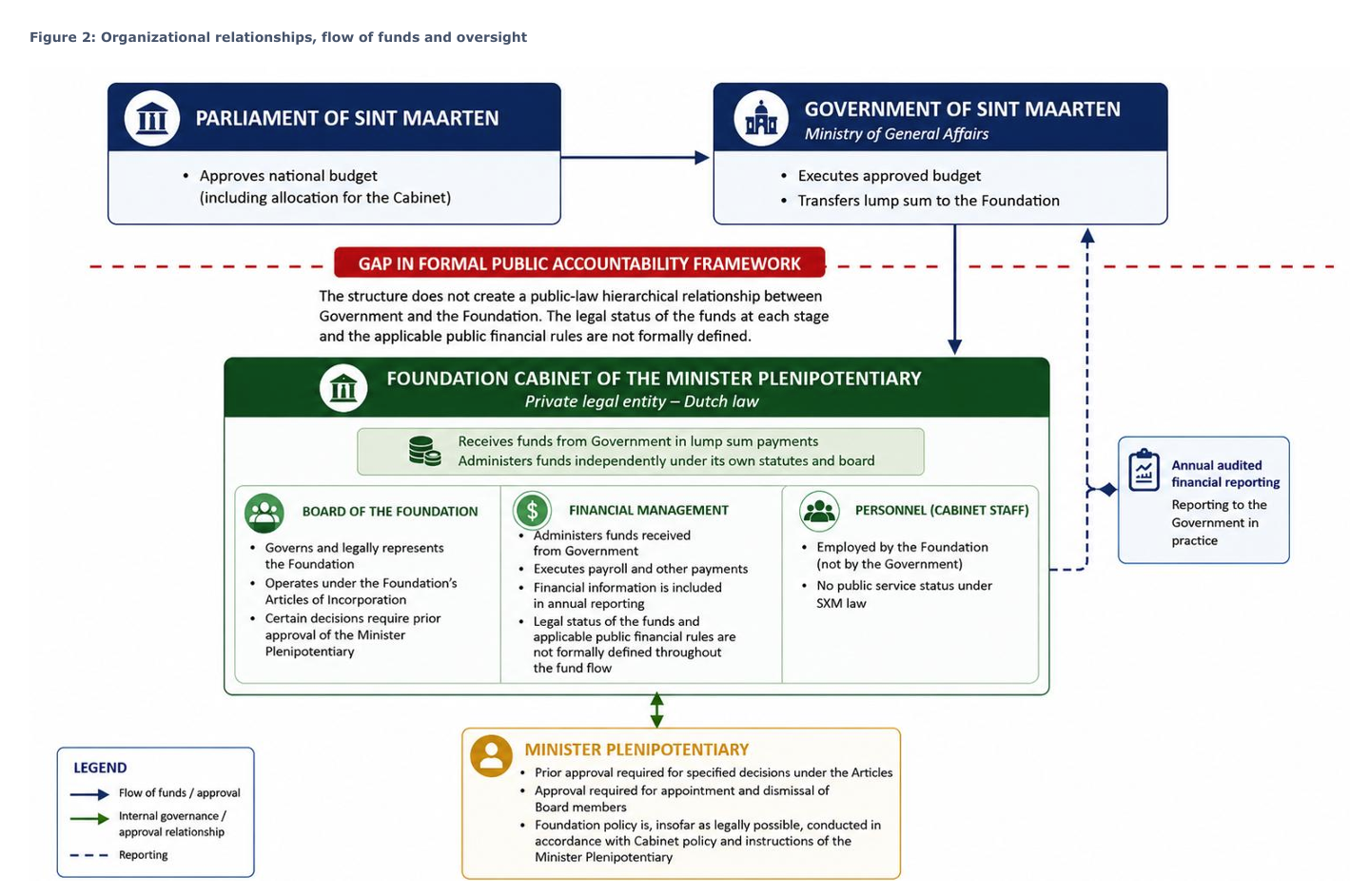
The audit's central finding was not that the Foundation had been operating secretly. It was that Government had failed to establish a comprehensive legal framework connecting the Foundation's financial management to public accountability and parliamentary oversight.
The Foundation's letter rejects the characterization of a "shadow construction," although that characterization does not appear in the Audit Chamber's report.
The existence of financial reports and government knowledge of an arrangement does not automatically establish that the arrangement satisfies the legal requirements for managing public money.
That is the underlying issue, and the Foundation's historical explanation does not resolve it.
The Financial Findings That Remain Unanswered
Beyond the constitutional and historical debate, the Audit Chamber identified several specific financial matters that received little substantive attention in the Foundation's response.
Among the most significant was the movement of public money between the Foundation and a separate Cabinet bank account. Funds approved by Parliament are transferred to the Foundation, a Dutch private-law entity, before portions move to the Cabinet account and, in some instances, back to the Foundation.
The auditors found that the legal ownership of these funds, the applicable financial rules and the responsibilities for oversight were not clearly established throughout the process.
Of particular note was a €533,922 receivable recorded in the Cabinet's 2024 financial statements, representing government funds still held by the Foundation at year-end. Because the Cabinet is not itself a separate legal entity, the Chamber questioned who legally holds the claim to those funds.
This finding does not establish that money is missing or improperly spent. It raises a question about legal ownership and accountability that the Foundation's letter does not answer.
The Chamber also found uncertainty concerning financial reporting. Although annual statements were audited, they were prepared in the name of the Cabinet, which lacks separate legal personality. Meanwhile, auditors did not identify separate financial statements for the Foundation, despite requirements in its Articles of Incorporation.
The external accountant acknowledged that the arrangement represented a "grey area" and had previously recommended changes to the way money and personnel arrangements were managed.
Another significant finding concerned financial authorization. Neither the Minister Plenipotentiary nor the Cabinet Director appeared in the mandate register examined by the Chamber, leaving auditors unable to confirm their formal authority to enter into financial obligations on behalf of the Country.
At the operational level, none of the sampled invoices had purchase orders attached, and the supporting documentation did not provide a complete record of the required financial checks. The Chamber also identified overlapping responsibilities involving the authorization of obligations, payment approvals and petty cash management.
Additional concerns involved €91,195 in vehicle-related costs in 2024, when the Cabinet maintained three vehicles, benefits governed by a 2012 Council of Ministers decision without maximum limits for several recurring expenses, and weaknesses in asset registration and inventory verification.
The audit acknowledged that the vehicle fleet was subsequently being reduced and that some financial controls were in place. It did not establish fraud or conclude that the expenditures themselves were unlawful.
Nevertheless, the findings raise questions about whether the necessary safeguards, authorization procedures and records are sufficiently established and documented.
The Foundation's letter defends the legitimacy of the institution but does not substantially explain these financial findings, whether corrective measures have been implemented or what further action is required.
Where the Foundation Has a Point
The Foundation's strongest argument is that Government cannot distance itself from an institution it has funded, recognized and relied upon for more than fifteen years.
In fact, the Audit Chamber largely supports that position.
Its report acknowledges that Government participated in establishing the funding arrangements and that the need for accounting and reporting conditions was already recognized in 2011. Yet auditors found insufficient evidence that those requirements subsequently developed into a comprehensive formal framework.
The Chamber also recognizes the Foundation's practical role as the legal employer of personnel under Dutch law, the existence of internal financial procedures and efforts by the Cabinet to prepare documents intended to formalize its operations.
Importantly, the Chamber did not recommend that the Foundation automatically be abolished.
It presented three possible approaches: formalize the existing structure through agreements, discontinue the Foundation-based arrangement and place operations directly within Government, or establish a formal legal framework governing the Cabinet.
That leaves open the possibility that the Foundation could continue performing its existing functions, provided the outstanding governance and accountability issues are addressed.
The authors' assertion that legislative proposals have been pending since 2018 deserves particular attention. If such proposals were developed to correct the institutional shortcomings, Government should explain where they stand, who was responsible for advancing them and why they remain unfinished.
This is also where the Foundation's response exposes a broader problem. The institution may have operated for years under arrangements inherited from an earlier constitutional system, but successive governments were responsible for determining how those arrangements should function under the laws of Country St. Maarten.
The Foundation's history may explain how the current situation developed. It cannot, by itself, justify allowing the identified weaknesses to continue indefinitely.
Government Must Now Provide Substantial Answers
The Audit Chamber's findings and the Foundation's response place responsibility squarely before the Government of St. Maarten, particularly the Ministry of General Affairs and the Ministry of Finance.
Several questions now require clear, documented answers.
First, why was the legal framework never completed? If draft legislation has existed since 2018, was it formally submitted to Government, reviewed by the relevant institutions or considered by the Council of Ministers? What prevented its advancement, and what is its current status?
Second, what is the legal status of public money transferred to the Foundation? Government must clarify ownership of the funds, the responsibilities governing transfers between the two accounts and the €533,922 receivable identified in the 2024 financial statements.
Third, who has the authority to make financial commitments? The Audit Chamber could not confirm the necessary formal mandate for the Minister Plenipotentiary or Director to enter into obligations on behalf of the Country. Government must identify the applicable legal arrangements and explain how any deficiencies will be corrected.
Fourth, what has Government actually done with the annual financial statements it receives? Were the reports reviewed, were shortcomings identified, and what instructions or corrective measures followed? Simply receiving audited accounts does not demonstrate that adequate government oversight has occurred.
Fifth, how will Government address the operational findings? This includes procurement documentation, separation of financial duties, verification of assets, vehicle expenditure and the modernization of allowances and benefits. Which responsibilities fall to the Foundation and Cabinet, and which require government decisions?
Finally, which of the three governance options identified by the Audit Chamber will Government pursue, and when will Parliament receive a timetable?
These questions are especially important because the Audit Chamber found that the current arrangement required the Foundation's consent for direct examination of certain financial activities, even though the funds originated from St. Maarten's national budget.
That illustrates the need for a formal framework establishing access to financial records, oversight powers and public accountability.