

Prepared to Participate, or Prepared to Compete? The competition gap is wide
.jpg)
St. Maarten has no shortage of young people willing to wear the national colors. The more difficult question is whether the country is preparing enough of them to compete once the opening ceremony is over and the whistle sounds. No one seems to want to have that discussion. But it is one, an honest one, that must be had if we truly want to close the regional competition gap.
Recent regional competitions have placed that question squarely before the sporting community.
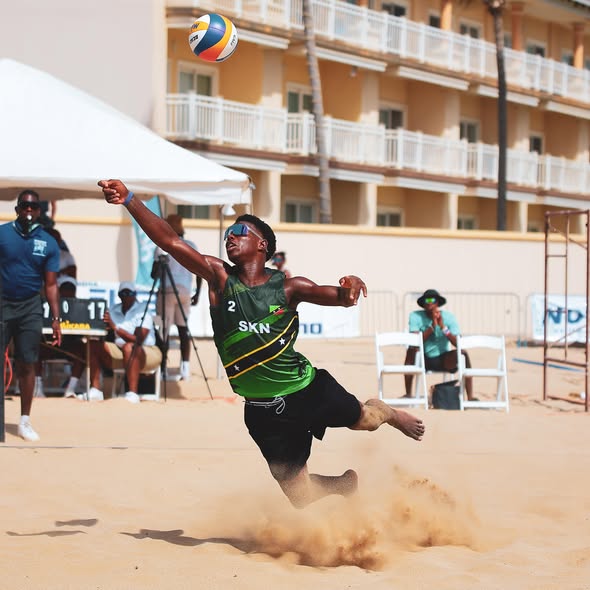
At the Eastern Caribbean Volleyball Association Under-20 Beach Volleyball Championship in St. Kitts, St. Maarten completed the competition with one victory. At the Latin America and Caribbean Junior League Baseball Tournament, the host team showed flashes of ability, including a 16-5 win over Argentina, but the competition also revealed differences in depth, execution and consistency against established regional programs.
The picture became clearer at the Central American and Caribbean Games in Santo Domingo, where St. Maarten’s swimmers were competing against some of the strongest athletes in the region. Several finished at or near the back of their heats, sometimes separated from the leading swimmers by margins that are significant in a sport measured in fractions of a second.
That does not mean the swimmers gained nothing. Three of the four lowered their times in the 50-metre breaststroke B finals. Emmbriel Flanders improved from 32.53 seconds to 31.54, while Adaya Bourne lowered her time from 37.23 to 36.70. Improvement under championship conditions deserves recognition. However, Mexico’s winning times in the A finals were 27.74 seconds for the men and 31.35 for the women. Those figures show, without attacking or embarrassing any athlete, how much work remains.
Regional competition has a way of removing comforting explanations. St. Maarten must therefore decide what it wants national representation to mean. Is it enough to attend, participate and return with experience, or should representation be the final stage of a serious development process designed to produce competitive performances?
Participation has value, particularly for young athletes gaining their first exposure. It cannot, however, remain the permanent objective. At some stage, a serious athlete wants to perform well, advance, place or win. The system surrounding that athlete must be designed with the same ambition.
Olympic and world champion water polo player Maro Joković offered a direct warning about the difference between potential and sustained development: “If you don’t work on yourself after the initial burst, you will remain only a potential big player. You will remain average.”
Preparation
Teams should not be assembled a few weeks before a tournament simply because an invitation was received or funding became available. That approach may produce a delegation, but it rarely produces a competitive team.
Serious preparation begins months in advance. Athletes must know the events being targeted, the standards required and the schedule that will take them there. Coaches must develop seasonal training plans rather than relying on occasional practices or hurried training camps.
For an older national-level athlete, commitment may mean training five or six days each week. At certain stages, it may include two sessions on selected days, technical work, strength and conditioning, mobility, recovery and practice competitions. The exact workload will differ according to age, sport and physical development, but regional-level performance cannot be built around training only when everyone is available.
International water polo coach Carlo Silipo recently captured the level of commitment required to compete in a strong field by saying simply: “The competition is very tight so you must work every day, every hour, every minute and more. Else why do it?”
A volleyball pair needs months to develop communication, movement, serving strategy, defensive positioning and an understanding of how each player responds under pressure. A baseball team needs repeated game situations, pitching development, defensive drills, batting work and competition against quality opposition. Those qualities cannot be created during a final week of practice.
Swimming requires the same structure. Pool time alone is not enough. Starts, turns, underwater phases, stroke efficiency and race management must be repeated until they become automatic. Strength training, supervised according to the athlete’s age and development, can help build the power and muscle needed to compete more effectively. Nutrition, hydration, sleep and recovery must also be treated as part of training, not as optional advice given shortly before departure. World Aquatics identifies training load, properly timed nutrition, hydration and recovery as important parts of swimming performance.
The Australian Institute of Sport places nutrition firmly within the athlete’s overall preparation: “Well-planned eating practices help athletes to train hard, stay healthy and injury-free, and compete at their best.”
Commitment must come from every direction
Athletes carry the greatest responsibility. Coaches can prepare programs, parents can provide support and government can finance facilities, but no one can complete the repetitions for the athlete. A serious athlete must attend training consistently, accept correction, manage social activities, protect rest periods and make choices that support performance. Talent may open the door, but discipline determines how far the athlete travels.
The point, as Olympic swimming coach Bob Bowman has also stressed, is the value of concentrating on the details of each training session: “Focus on your stroke and sometimes that will turn things around and sometimes it’s what you get out of that day.”
Coaches also have to be honest. Selection should not be based primarily on availability, relationships or the desire to fill a delegation. Coaches must establish measurable standards and tell athletes where they stand. That may be uncomfortable, but false encouragement followed by a heavy regional defeat does little for confidence or development.
Parents have an equally important role, especially with young athletes. Commitment may require transportation to early practices, proper meals, travel to competitions and the willingness to support a demanding schedule. Parents must encourage their children, but they must also understand that national-level sport requires more than enthusiasm.
Government’s role is important but more limited. Government can improve pools, courts, fields and gyms. It can assist with travel, equipment, coaching education and development programs. What it cannot manufacture is daily commitment.
A modern facility will not compensate for irregular training. New uniforms will not correct poor technique. Travel funding will not replace months of preparation.

Funding must follow readiness
The St. Maarten Sports Federation deserves credit for rebuilding its organization and restoring a central body through which sporting associations can cooperate. Its new structural subsidy agreement with government provides support for national uniforms, institutional development and eligible operating expenses. It also requires regular financial reporting and cooperation with the Department of Sports in gathering information from member organizations.
Long-term athlete development expert Istvan Balyi has argued that strong performances flow from the quality of the sporting structure supporting athletes: “The health and wellness of the nation and the medals won at major Games are simple by-products of an effective sport system.”
In other words, with that support must come stronger oversight of how athletes and teams are prepared. The Federation should not attempt to select every national team itself, but it should require associations seeking assistance to demonstrate that preparation is serious. Applications for funding should include training schedules, attendance records, athlete development plans, coaching qualifications, recent competition results and realistic performance targets.
Public funding should help athletes who have prepared to represent St. Maarten, not finance last-minute attempts to create representation. This does not mean athletes must already be medal contenders before receiving support. Development requires exposure. It does mean there should be evidence that the athlete has trained consistently, reached an appropriate standard and is physically and mentally prepared for the level of competition being entered.
Leaving St. Maarten may be part of the solution
Honesty about St. Maarten’s limitations is also necessary. The country has a small population, limited competition in several sports and relatively few opportunities to train daily against athletes of a high standard. For some athletes, reaching the next level may require leaving St. Maarten.
That should not be treated as rejection or failure. Many successful Caribbean athletes develop through overseas universities, academies, clubs and high-performance centres. They leave because stronger competition, specialized coaching, sports science and better training partners are essential to their growth.
St. Maarten should actively identify athletes with the potential and commitment to benefit from those pathways. Associations, schools, businesses, government and the Sports Federation can help them secure scholarships, training placements and connections with established programs. The goal should not be to keep every talented athlete at home. The goal should be to help that athlete reach the highest possible level and continue representing St. Maarten.
National representation should be the result of preparation, not a substitute for it. Wearing the uniform should reflect months and years of attendance, discipline, coaching, sacrifice and measurable progress. St. Maarten’s athletes do not need sympathy, and they should not be ridiculed when results fall short. They need honesty, structure and adults prepared to build a system that matches their ambitions.
The regional gap will not close during one tournament or one funding cycle. It will begin to close when St. Maarten stops measuring success by whether a team arrived and begins measuring whether that team was truly prepared to compete.