




GREAT BAY--Democratic Party leader and President of Parliament Sarah Wescot-Williams announced Sunday that the party is beginning a formal leadership transition toward what she described as "DP Era 3," with plans to identify a Deputy Leader who will eventually succeed her as political leader.
Addressing the party's National Council Congress on November 22, Wescot-Williams said the transition must begin in time for the 2028 elections, while also delivering a critical assessment of the coalition government's first two years and calling for substantial changes in how the remaining governing term is managed.
Wescot-Williams described the planned transition as the beginning of a new chapter, a new era, in the Democratic Party's 72-year history, following two periods of leadership associated with party founder Claude Wathey and herself. She made clear that the position of Deputy Leader would be intended for someone preparing to assume the party's leadership, with a transition process designed to position the organization for the next parliamentary election.
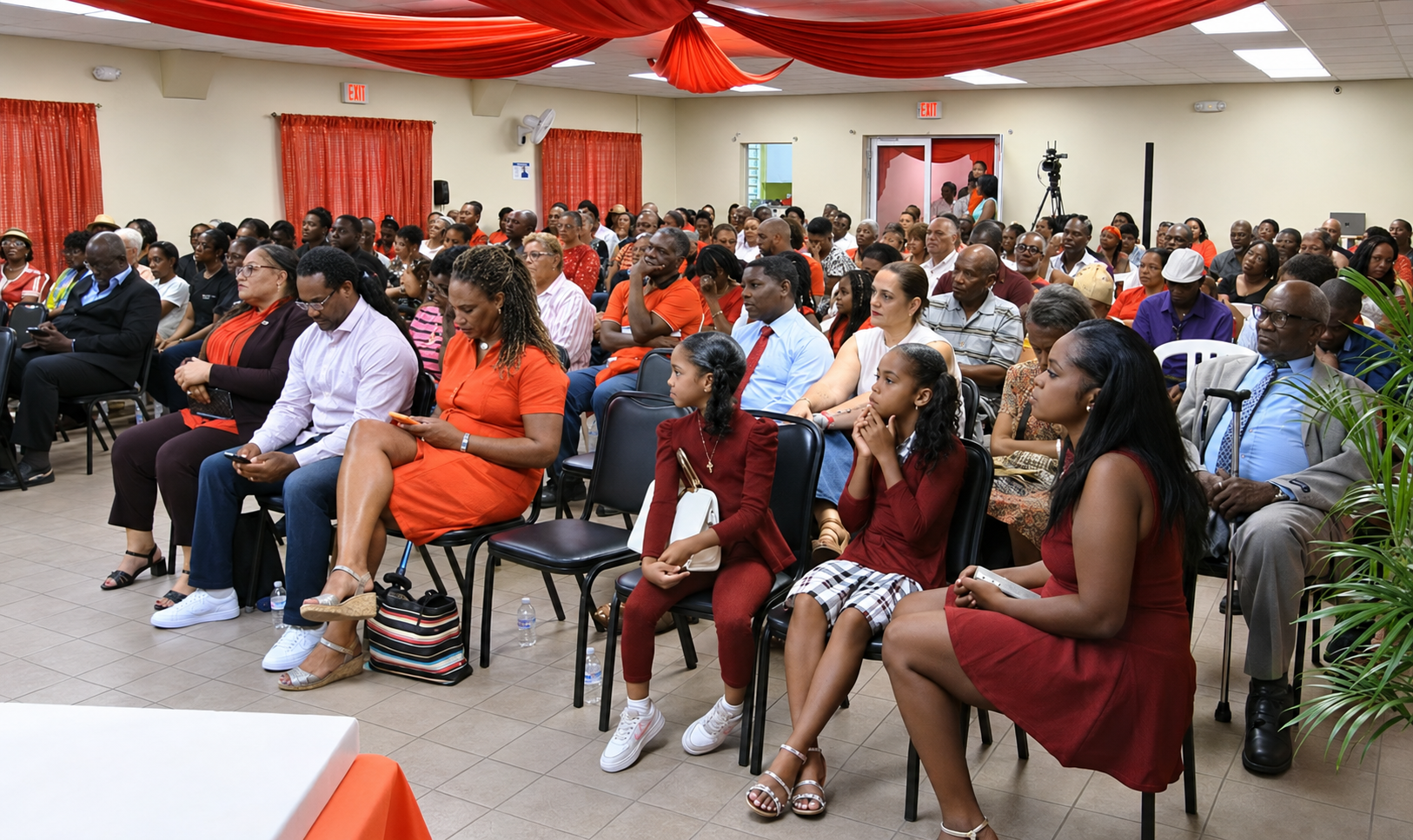
"This is also the first step towards this party's transition to DP era number 3 beginning with identification of the Deputy leader of this great institution and a process of transition to be ready for 2028," she told party members and supporters gathered at the John Larmonie Center.
The announcement represents a significant development for the Democratic Party, which has been led by Wescot-Williams for much of its modern political history. She said the party must begin identifying individuals willing to assume responsibility for its future while maintaining the principles and organizational structures that have sustained it through different political periods.
Wescot-Williams outlined the qualities she expects from a future leader, identifying loyalty, principled conduct, strategic thinking, inclusive leadership and dedication to country and party as requirements. She emphasized that the Deputy Leader would be expected to prepare for the responsibility of leading the party, with her continued guidance and support throughout the transition.
She encouraged potential candidates to make their interest known, indicating that she hoped individuals would begin coming forward within the coming week. Wescot-Williams also made clear that she intends to approach suitable individuals herself if necessary, stressing that the future leadership must come from people prepared to dedicate themselves to public service.

The DP leader framed the transition within a review of the party's history, recalling its establishment in 1954 by Claude Wathey and Clem LaBega and its role in St. Maarten's political, economic and constitutional development. She traced the party's evolution through electoral victories, periods of opposition, constitutional negotiations and the transition to country status on October 10, 2010.
Wescot-Williams recalled the 2000 constitutional referendum, in which nearly 70 percent of participating voters supported separate status for St. Maarten within the Kingdom of the Netherlands. She described the negotiations that followed, including discussions on debt relief, law enforcement and financial supervision, as a lengthy process that required difficult decisions and compromises.
She also reflected on her appointment as St. Maarten's first Prime Minister following the 2010 parliamentary election, when the Democratic Party secured two of the 15 seats. Despite its limited parliamentary representation, she said the party was entrusted with leading the country's first government because of its experience in constitutional affairs and the establishment of the new governmental structure.
During that period, the former island administration was transformed into a national government, with ministries and institutions established to support St. Maarten's new constitutional responsibilities. Wescot-Williams pointed to the creation of institutions such as the Council of Advice, General Audit Chamber, Ombudsman and Constitutional Court as part of the foundation established during the transition.
Turning to more recent political developments, Wescot-Williams recalled the party's electoral setbacks following 2010, its participation in the United Democrats arrangement in 2018 and its reduction to one parliamentary seat in 2020. She said the party's regeneration meeting in January 2023 marked an effort to rebuild its organization and move away from a political culture dominated by individual personalities.
She credited that process with contributing to the party's recovery in 2024, when it secured two seats in the January parliamentary election and increased its representation to three seats in the August election. With Democratic Party representatives now serving in Parliament and Ministers holding the portfolios of Finance and Tourism, Economic Affairs, Transport and Telecommunication, Wescot-Williams described the party as having regained a significant role in government.
"The Democratic party is once again a pillar of stability in this country," she declared, emphasizing that political stability must be supported by effective governance and the delivery of commitments made to voters.
However, Wescot-Williams offered a critical assessment of the coalition government's performance over the first half of its term. The Democratic Party currently participates in a four-party coalition governed by a coalition agreement, but she acknowledged that the first two years had been difficult in terms of fulfilling the mandate given by voters.
"How have these two first years of this Coalition gone? Rough. Rough in terms of fulfilling our mandate to the people of St. Maarten," she stated.
She argued that progress had repeatedly been slowed or reversed by various constraints within government, describing a situation in which forward movement was frequently followed by setbacks. Wescot-Williams said the remaining two years must be approached differently and that the Democratic Party should take a leading role in bringing about the changes she believes are necessary.
"The next two years towards the end of this term have to change and the Democratic party needs to lead this change. I don't see change happening otherwise," she told the congress.
The DP leader also cautioned against remaining in government simply to maintain political arrangements without achieving results for residents. She stressed that the party's participation in the coalition must be measured by its ability to contribute to improvements in people's daily lives.
"Just going along to get along is not helping us and we need to stand up the way we have stood up in all of those times that I mentioned before," she said.
Throughout her address, Wescot-Williams placed emphasis on rebuilding political institutions and encouraging younger generations to become involved in organized political life. She urged aspiring leaders to understand the country's Constitution, the institutions responsible for protecting democratic governance and the responsibilities that accompany elected office.
She also criticized what she described as a political culture centered on personalities, arguing that political parties should be guided by principles, organizational structures and a vision for the country. According to Wescot-Williams, prospective candidates should demonstrate commitment to their communities before seeking public office, through service in schools, cultural organizations, neighborhoods and other civic institutions.
Wescot-Williams further emphasized the importance of protecting St. Maarten's constitutional autonomy through responsible governance. She warned that failures in public administration and political scandals can weaken the country's standing and provide arguments for greater external involvement in its affairs.
She encouraged future political leaders to be capable of representing St. Maarten across the Kingdom of the Netherlands and the wider Caribbean, while understanding the economic and social concerns facing residents on both sides of the island. She expressed concern that St. Maarten had lost some of its former regional standing and called for renewed efforts to strengthen its position.
Returning to the leadership transition, Wescot-Williams said the Democratic Party must ensure that its future is built around individuals who can carry forward its institutional history while responding to present-day challenges. She emphasized that the next leader must be prepared to assume responsibility for the party's direction and work toward the 2028 election.
She assured prospective successors that they would have her support throughout the process, describing a gradual transition in which she would initially lead, then work alongside the incoming leadership before eventually taking a supporting role.
The party leader also acknowledged the difficulties residents are experiencing, including financial hardship and the emotional strain associated with continuing economic and social challenges. She urged party members to remain committed to addressing those concerns while preparing the Democratic Party for its next generation of leadership.
Wescot-Williams concluded by encouraging individuals who believe they have the dedication and ability to lead the party to come forward, emphasizing that the next chapter of the Democratic Party must be shaped by people willing to accept responsibility for its future and the country.
"It's not about the next Sarah, it's about the next person who wants to take this party and run with it," she said, underscoring her intention to begin the leadership transition while continuing to pursue changes within the current coalition government.
Join Our Community Today
Subscribe to our mailing list to be the first to receive
breaking news, updates, and more.