





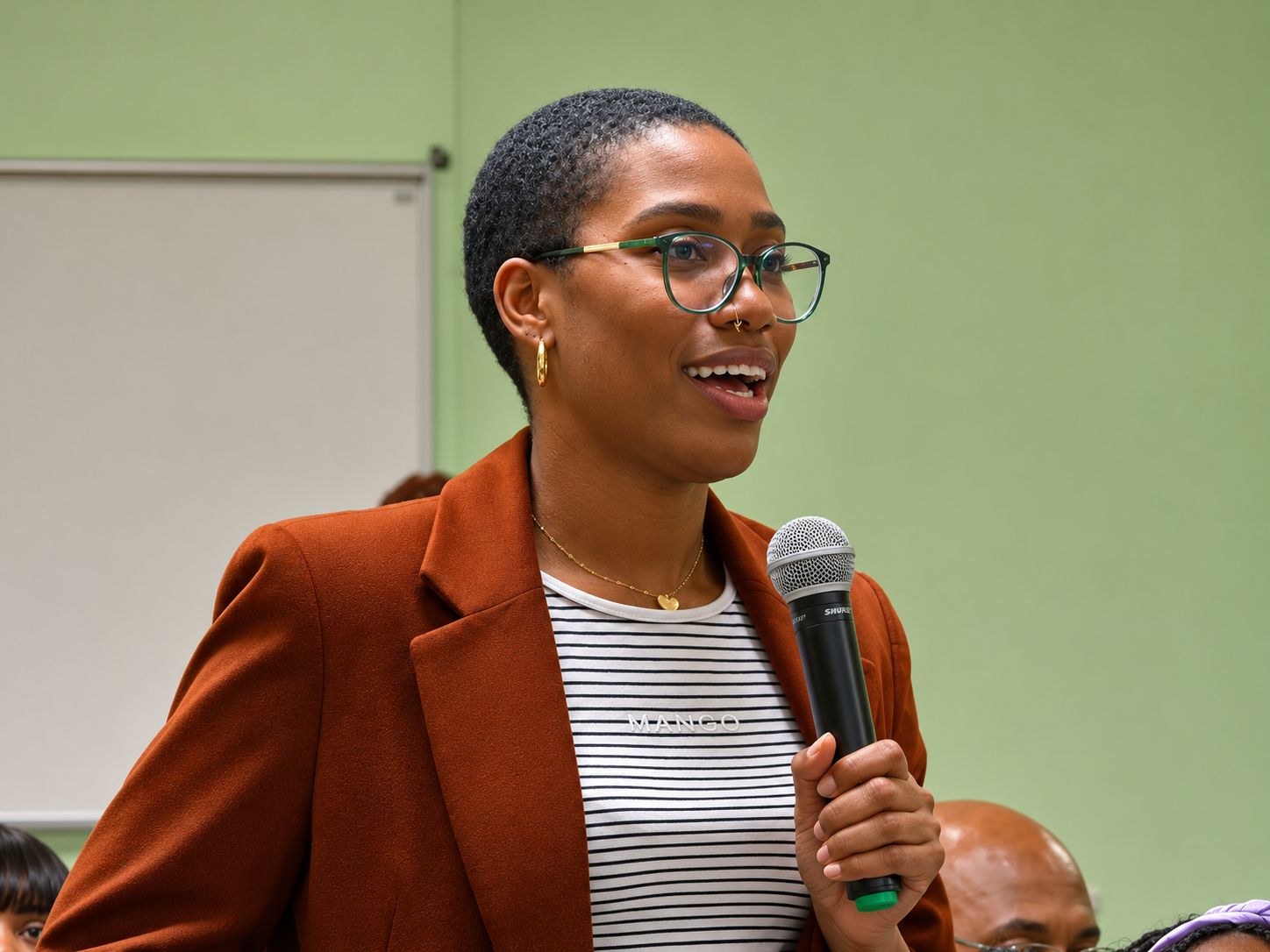
GREAT BAY-- Members of the public challenged institutions, legislators and community organizations to turn the findings of the Ombudsman’s investigation into domestic abuse into concrete action during an interactive discussion on Tuesday evening at the University of St. Maarten. Questions from the audience focused on how citizens could sustain public attention, how survivors could receive better assistance across both sides of the island and what immediate measures could be introduced to give children a greater voice.
The discussion followed the premiere of the documentary “Behind Closed Doors,” hosted by the Ombudsman of St. Maarten. Audience members raised concerns based on personal experiences and offered suggestions for legislative changes, educational initiatives and community involvement.
One audience member, who indicated that he had read the Ombudsman’s report twice, questioned where legislators should begin in addressing the identified legal shortcomings and how members of the public could help maintain awareness and hold the relevant authorities accountable.
He expressed concern that the extensive work undertaken by the Ombudsman and her team could eventually be overshadowed by other national issues, leaving the recommendations without sufficient follow-up.

Responding to the question, Ombudsman Gwendolien Mossel indicated that she believes the Ministry of Public Health, Social Development and Labour (VSA) should assume the leading role in coordinating government’s response to domestic abuse. She also encouraged residents to participate in maintaining public awareness and supporting individuals experiencing abuse.
Mossel cautioned against dismissing survivors who experience difficulty leaving abusive relationships, urging residents to continue providing assistance and directing individuals towards available support.
“Don't give up on them. Keep asking, keep helping, keep showing the way,” Mossel said.
A survivor calls for cross-border cooperation
One of the survivors featured in the documentary addressed the audience directly, drawing attention to difficulties she experienced because her circumstances involved both the Dutch and French sides of the island.
She attributed shortcomings in the handling of her situation to an absence of communication between the two jurisdictions and questioned how victim support organizations and other authorities could work together to prevent similar experiences.
The survivor emphasized that assistance must account for the realities of life on an island governed by two jurisdictions, particularly when family relationships, residency and other personal circumstances involve both sides.
Mossel disclosed that her office had intended to meet with representatives of shelter services on the French side during the investigation but had been unable to complete that engagement. She confirmed that those discussions would still be pursued.
The Ombudsman also identified an opportunity to examine the French side’s approach to providing temporary refuge for individuals who need time away from abusive circumstances, even when they are not yet prepared to permanently leave their relationships.
When children are told to remain silent
Another audience member questioned how educators could encourage children to disclose abuse when they have been instructed by their parents that what happens at home must remain at home.
Licensed psychologist Stephanie Haseth responded that professionals should recognize that children may need considerable time to develop trust before discussing sensitive experiences. She explained that adults should avoid expecting immediate answers and instead create opportunities for children to communicate in environments where they feel comfortable.
Drawing on her private practice, Haseth explained how play can help establish communication with children without creating the impression that they are being questioned or reprimanded.
She also cautioned professionals to carefully assess how information disclosed by children is subsequently handled, particularly when communicating that information directly to parents could place the child at further risk.
Young people want earlier education and better parenting support
An audience member also questioned whether education about coercive control and abusive relationships could be incorporated into school curricula, referencing the experience of a survivor whose abusive relationship began while she was still attending school.
Victim Support Services Director Cassandra Richardson disclosed that awareness sessions had previously been conducted in individual classrooms during her tenure at Safe Haven, largely at the request of interested teachers. However, those initiatives had not been introduced across the education system on a sufficient scale.
The exchange prompted members of the Ombudsman’s investigation team to share additional insights from their discussions with young people during the investigation.
Young participants reportedly expressed dissatisfaction with the timing and scope of existing sexual education, indicating that information about relationships, self-esteem, self-worth and personal safety was being introduced too late.
Interestingly, the young participants also requested additional educational support for their parents, describing the assistance they envisioned as parenting school. They expressed a desire for parents to receive guidance on communicating with and understanding their children.
Roseburg proposes dedicated telephone service for children
Member of Parliament Sjamira Roseburg addressed the need to update St. Maarten’s legislation, noting that several parliamentarians are working on amendments to outdated laws, including the Criminal Code and Code of Criminal Procedure. She emphasized the need to strengthen the legal position of victims, who she believes currently receive insufficient protection under existing legislation.
Roseburg also proposed establishing a dedicated telephone service through which children could ask questions, express concerns and seek assistance. She referenced similar services available on St. Eustatius, Aruba and Curaçao.
While acknowledging that legislative amendments would be required to establish a Children’s Ombudsman, Roseburg suggested that introducing a dedicated telephone service could be explored as an immediate measure without waiting for those legislative changes.
Her proposal was intended to provide children with an accessible avenue to communicate their concerns while work continues on establishing a formal independent mechanism for protecting children's rights.
Responding to Roseburg, Curaçao Ombudsman Keursly Concincion recalled the difficulties encountered when introducing independent children's rights oversight in Curaçao, including initial resistance from organizations concerned that their responsibilities would be taken away.
He disclosed that, during his six years exercising a children's rights mandate, he had repeatedly encountered professionals working within the same child protection sector who met one another for the first time at his office. His experience illustrated the extent to which organizations responsible for assisting the same population can operate without sufficient interaction.
Wescot-Williams invites Ombudsman to Women’s Caucus
Chairlady of Parliament Sarah Wescot-Williams extended an invitation to Mossel to discuss the investigation’s recommendations with Parliament’s Women’s Caucus, proposing that members examine their feasibility, establish priorities and identify who would be responsible for carrying them out.
Wescot-Williams noted that the Caucus had previously discussed several concerns surrounding domestic abuse with Richardson and expressed the desire to build on those discussions.
“I would hate for this report to go on a shelf and next two years for you to have to follow up and conclude that not much happened,” Wescot-Williams stated.
MP Francisco Lacroes subsequently proposed extending the engagement to the entire Parliament, emphasizing that the subject must also receive the attention of male parliamentarians. In an emotional contribution, Lacroes reflected on his own childhood and circumstances involving his mother.
He announced that his faction staff would contact the Ombudsman on Wednesday to work on a budget amendment aimed at securing funding for a Children’s Ombudsman. The proposed amendment has yet to be formally presented or approved.
Community organization offers immediate assistance
The final contribution from the audience came from Sana Bartels, who informed attendees about an existing program operating under a public health initiative called “A Restorative Approach to Transgressive Behavior.”
Bartels disclosed that four places remained available for families and individuals seeking professional assistance in addressing harm within their relationships.
The program is offered free of charge and involves trained mediators conducting separate preparatory sessions with participants before assessing opportunities for a restorative process.

Mossel reflects on the investigation
Asked by an audience member to identify the greatest challenge encountered during the investigation, Mossel said the volume of information collected made consolidating the findings into a single report particularly demanding.
She disclosed that members of her team frequently worked beyond regular office hours, sometimes until 9:00 p.m. during the final weeks, to complete the report and documentary ahead of November 25, the International Day for the Elimination of Violence Against Women.
Mossel credited the survivors who agreed to share their experiences, the school care teams, young people and other participants whose contributions made the investigation possible.
She also indicated that extended interviews with survivors and experts would be released and that her office would explore opportunities to take the documentary into communities across St. Maarten as part of continued public awareness efforts.
Join Our Community Today
Subscribe to our mailing list to be the first to receive
breaking news, updates, and more.